Maintenance
Steam Turbine Overhauls — Level B vs Level C, Explained
Level B and Level C are depths of opening, not grades. This post sets both scopes side by side, then walks through a real minor overhaul — thrust clearance over its limit, scored control valve spindles, a trip bolt that failed its first attempt — and the rule for choosing between them.
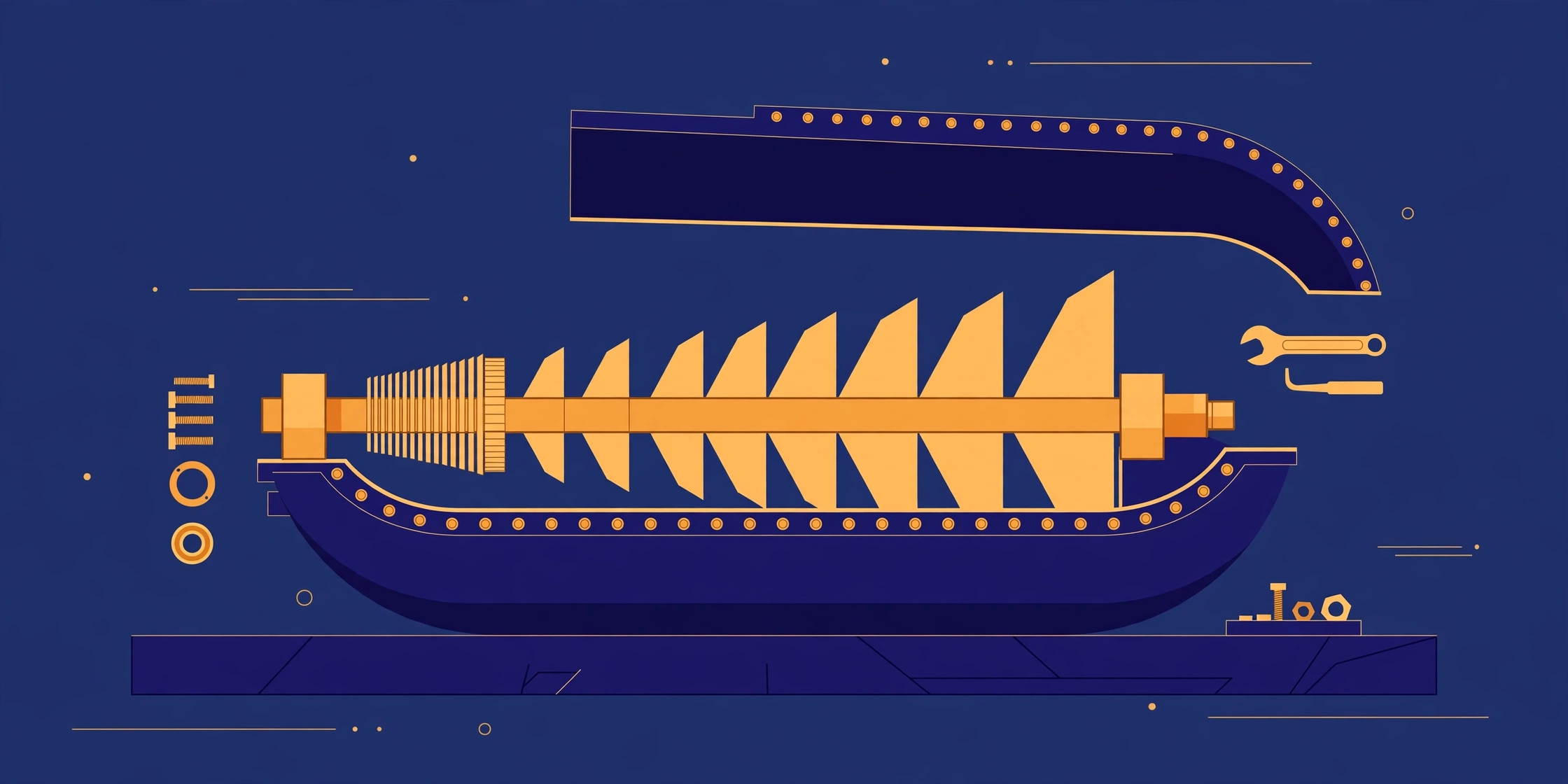
A steam turbine does not ask for attention the way a gas turbine does. It has no hot-section clock ticking in thousands of hours, no combustor to watch. It just runs, year after year, until the outage plan arrives with a letter on it — B or C — and that letter decides how long the machine is down, how much of it gets opened, and how much of the outage budget gets spent. People treat the letter as a grade. It is not. It is a depth of opening, and it is worth knowing exactly what each depth buys you.
Two warnings before the detail. First, the letters do not mean the same thing everywhere: different manufacturers and different manuals use different ladders, and the same letter can carry a different scope on a different machine. The letter is shorthand. The scope document is the job. Second, the scopes below are written in general terms, drawn from the GE steam turbine manual for the other turbine I look after — its inspection calendar and its disassembly and inspection procedures — and from a real minor overhaul I was on the plant side of at SGTPS. They describe typical depths. Your machine's own manual governs its own outage.
The two scopes, in general
A Level B is an intermediate opening. A Level C is the full strip. The table below sets them side by side, area by area.
| Area | Level B — intermediate | Level C — full |
|---|---|---|
| Casing | Top half lifted; lower casing stays in place | Fully split; rotor lifted out |
| Rotor | Stays in the lower casing; journals and thrust collar inspected and polished | Out of the machine; full inspection, non-destructive testing, balance checked |
| Diaphragms and blade rows | Exposed; clearances measured row by row; deposits and erosion recorded | Every row accessible; blades and seals replaced as found |
| Bearings and thrust | Journal and thrust bearings inspected; clearances measured and adjusted | Bearings and thrust components renewed or fully reworked; spacer plates replaced |
| Seals and glands | Checked for leakage and wear; clearances measured | Replaced as found; fits re-established |
| Stop and control valves, servomotors | Stripped and measured — spindle and bush diameters, seats, linkage, lifts set | Same, plus worn assemblies replaced complete — covers with bushes already fitted — and servomotors fully overhauled |
| Gearbox and couplings | Inspection cover off; teeth and backlash checked; couplings inspected; alignment checked | Gearbox bearings inspected and cleaned; tooth contact checked; alignment re-established from scratch |
| Oil system and auxiliaries | Skid inspected; pumps, filters and accumulator checked; hoses replaced as scheduled | Full auxiliaries overhaul; pumps, coolers and accumulators reworked |
| Instrumentation and protection | Sensors checked; trip and overspeed functions tested | Full protection proving; trip set points reset with machined shims and pins |
| Testing and NDT | Accessible parts only; borescope where the machine allows it | Full NDT across rotor and stationary parts |
| Run-up and return | Function checks, barring, run-up, overspeed test, synchronise | Same, plus full re-commissioning and load testing |
| Outage shape | Days to a few weeks, with contingency for findings | Weeks; crane time, specialist labour, spares depth |
The manual behind that table also sets the rhythm that decides which depth is due. Its calendar puts bearing and thrust clearance checks and coupling alignment on a yearly basis; stop-valve control and steam-part checks, control-valve servomotors, bleed-valve servomotors and oil relays, and gearbox teeth and bearing housings on a two-yearly basis; and the turbine general inspection, the control valves themselves, grid-valve faces and edges, and the bleed valve on a four-yearly basis. Its standing rule matters more than the calendar: periodicity depends on operating conditions, fluid quality, inspection regularity and monitoring methods, and the operator sets the range from findings. A rising trend in vibration, seal leakage, bearing temperature or steam pressure calls the outage — not the calendar alone.
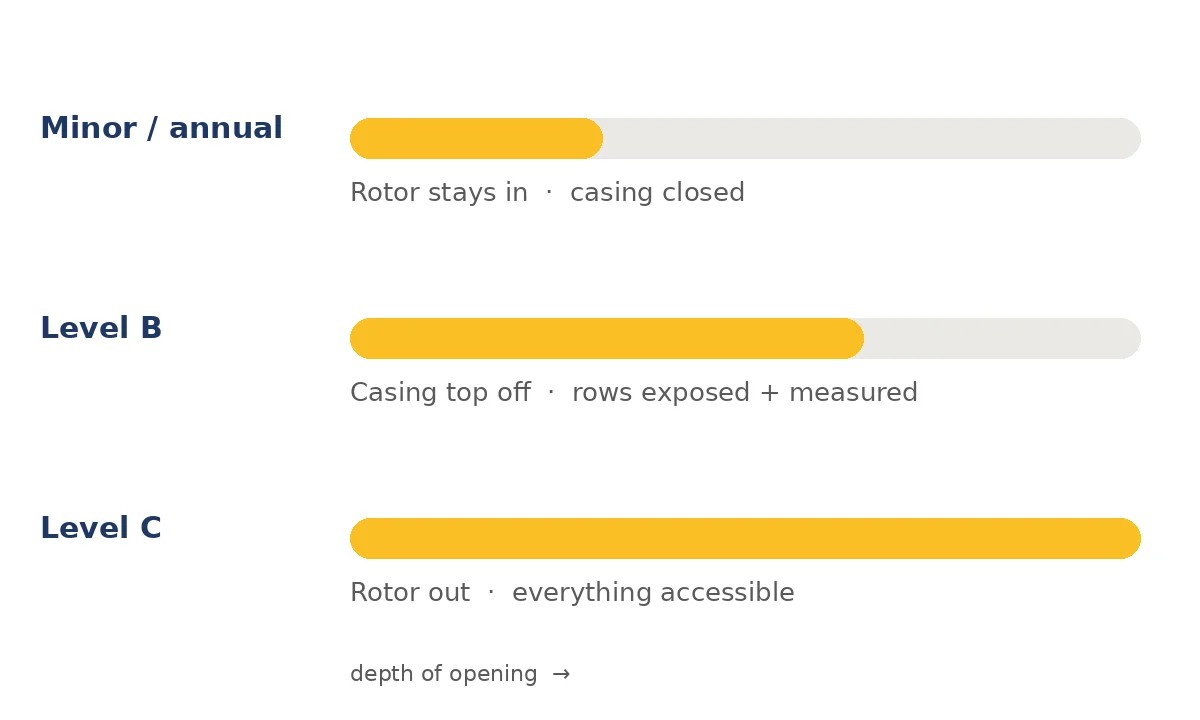
Figure: how far each depth opens the machine. A minor overhaul never splits the casing; a B lifts the top half; a C takes the rotor out.
What the scopes look like in practice — SGTPS, November 2019
In November 2019 we brought the maker's service engineers in for the annual minor overhaul of the 10 MW NG Allen steam turbine at SGTPS. I was on the plant side of that overhaul. The machine had run 13,348 hours and 207 starts when the control system was interrogated at shutdown. The planned scope was 14 days. The visit ran 2–20 November, nineteen days. A minor overhaul sits one depth below a B: the rotor stayed in place and the casing never split. What came off was everything around the rotor — both combined stop and emergency valves (CSEVs), all four inlet control valves with their linkage, both bearing pedestal caps, the oil baffles, the gearbox inspection cover and the couplings — with the last blade row viewed through the exhaust inspection hatch.
Its findings list is the best argument for taking scope seriously, because a shallow opening found problems at every depth the table above describes.
| Finding | As found | Disposition |
|---|---|---|
| CSEV seals, both sides | Seals had lost all sealing properties after long service without a change; oil had passed into the gland area and carbonised, blocking the gland drains | All piston seals changed |
| Control valve 2 spindle | Severe lateral scoring around 50% of the circumference, with a step worn into the spindle | New spindle fitted; short bush retained |
| Control valve 3 spindle and bush | Scoring around 40%; short bush non-acceptable | Bush retained; complete cover assembly recommended at the earliest opportunity |
| Control valves 1 and 4 | Scoring around 30% and 10% respectively | Acceptable; covers repainted with heat-resistant paint |
| Thrust clearance | 0.7 mm on opening — over the maximum permissible limit | Plates re-chamfered and reused in the opposite position; closed at 0.65 mm, at the limit |
| Journal clearances | Steam end 0.175 mm; exhaust end 0.18 mm, the same on opening and closing | Top halves polished; fit for service |
| Oil baffle clearances | 0.1–0.125 mm at both ends; knife edges good, no shaft rubbing | Fit for service |
| Last-stage blades, seen through the hatch | Clean, no deposits; leading-edge water droplet erosion | Recorded for the next, deeper scope — erosion cannot be measured properly through a hatch |
| Electro-hydraulic amplifier | About 70 mm total lift; 3.5% overclose | Set points had not drifted since commissioning; no action |
| Exhaust-end bearing temperature sensor | Outer sheathing damaged, inner wires showing | Listed as a required spare — RTDs for all bearings |
| Mechanical trip bolt | Failed the first attempt; tripped at 7,487 rpm on the second; spray nozzle 75% blocked with oil debris | Cleaned and cycled by hand; set-point drift confirmed; reset deferred to the next overhaul |
| Alignment | Initial and final high-speed sets acceptable; commissioning figures had not drifted far | Final low-speed alignment never taken — generator jacking oil pipe replacement deferred |
| Run-up | Full speed no load held 30 minutes; overspeed test at 110% of rated speed passed, protection and CSEVs tripping on two modules; about 12 hours on load with normal parameters | Returned to service; six hours of barring recommended |
### Read the starts, not just the hours
13,348 hours is not a large number for a steam turbine. 207 starts is. The thrust plate indentations were described as deep considering the minimal running hours, most probably down to the large number of start-stop cycles. The seals had aged out through time in service, not running hours. The trip bolt set point had drifted while the machine sat and cycled. A plan that counts hours alone would have called this machine young and healthy. A plan that counts starts, and reads the condition evidence, calls it a machine heading for a major overhaul — which is exactly what the maker's engineers recommended: a major overhaul within two years, at around 250 starts, with minor overhauls at 12-monthly intervals in between, during which the trip set point is checked and reset. Skip those minors, their warning ran, and the set point drifts outside the detectable range, turning a routine reset into lengthy testing with machined parts.
How to choose
The table below turns condition evidence into a depth. It is a guide, not a rule — the scope sheet for the machine in front of you is the rule.
| What you see | Points toward |
|---|---|
| Findings confined to valves, bearings and auxiliaries; rotor and blade rows sound | Minor or B — fix, record, monitor |
| Clearances drifting, blade-row erosion measured, rows you cannot reach from a hatch | B — open and measure |
| Rotor-level damage, thrust at its limit, parts you could not fix last time, trip set point drifted, starts approaching the major mark | C — full strip |
| Healthy machine, no adverse trends | No deeper opening — monitor, and let a rising parameter call the outage |
Three things should drive the choice, and only one of them is the calendar. The first is the manual's interval for the machine — hours and starts, as the manufacturer states them. The second is condition: vibration trends, gland leakage, the findings from the last inspection, and what running inspections have been hinting at since. The manual for the other turbine puts it as a discipline: keep the logbook and the historical register, consult it before every visit, and watch the trend in vibration, seal leakage, bearing temperatures and steam pressure. The third is readiness: outage window, spares on the shelf, crane and crew booked, and a scope sheet that says what happens if findings extend the work.
Readiness deserves a paragraph of its own, because the 2019 job taught it twice. The plan allowed 14 days and the visit took 19, and part of that was access: scaffolding around the steam end was not suitable and had to be modified before the CSEVs and control valves could come out, and fire suppression equipment over the exhaust-end bearing and the CSEVs had to be removed before the crane could traverse into position. The other lesson was spares policy. The maker's engineers were explicit that getting parts manufactured and modified accurately on site was a significant issue, and that spares going forward should be complete assemblies wherever possible rather than individual components — because with some components there is only one chance to machine them correctly, and a wrong one costs time and money together. The retained bushes are that lesson in miniature: the part you need is the assembly, ordered before the outage, not the bush, hoped for during it. The manual says the same in its own way: check the spares stock before programming a servicing operation, order in advance, and replace a worn part only with an identical one — same dimensions, materials, heat treatment and surface treatment.
There is a trap inside a C that a minor overhaul mostly avoids: while you are in there. Once a machine is fully open, every marginal part starts looking like a replacement candidate, and the scope grows by suggestion. The discipline is to replace on condition and evidence — a measurement, a test result, a visible defect — and to leave alone what still measures sound. An overhaul that replaces everything is not careful. It is expensive, and it puts new parts with their own early-failure risk into a machine that was running. The retained bushes from 2019 are the mirror image of that trap: sometimes the honest outcome is not a replacement at all, but a written recommendation and a part ordered for the next outage.
One more distinction worth keeping straight: this ladder belongs to the steam turbine. Gas turbines run on their own inspection levels — at Korangi, Level-3 maintenance on the LM6000 fleet meant module replacement and hot-section exchange, a different machine with different rules. Mixing the two ladders up in an outage plan is an easy error and a costly one.
The Takeaway
Before approving any steam turbine outage, ask for the scope sheet and read it line by line: what gets opened, what gets measured, what testing is included, which spares are already on site, and what findings would extend the scope. If the sheet matches the machine's condition and interval, the letter on the cover takes care of itself. Judge the outage by what the crew will actually open and measure — that is what you are paying for, and that is what decides whether the machine comes back better or just comes back reassembled.
Further Reading
Inside an LM6000 Hot-Section Exchange — Level-3 maintenance on a gas turbine, a different inspection ladder from the steam turbine levels above.
HRSG Inspections — What API 510 Makes You Look For — The steam-side inspection that pairs with a turbine outage: pressure parts, creep and corrosion.
Plant maintenance — pillar guide — The full maintenance guide, where inspection levels sit alongside the wider maintenance mix.
Siemens Energy — Power Plant Services — An OEM's view of steam turbine overhaul and service scope, including inspections, planned outages and component repair.
More from the blog
 ProjectsHow Owners Evaluate Bids — Inside a Techno-Commercial EvaluationA bid that passes pre-qualification, a technical read of the method, prices normalised to one basis and a whole-life view may still not be the cheapest — but it will be the one you can defend, to a board, an auditor, and the plant that has to live with it.Read post →
 MaintenanceMinor at 30K, Major at 60K — The Rhythm of Engine OverhaulsAn engine wears out on hours, not dates. The 30,000-hour minor is a checkpoint whose measurements shape the 60,000-hour major — and across a 32-engine fleet, sequencing, spares and records are what make the programme work.Read post →
 EnergyWhy the Grid Struggles at 7 pm: Peak Demand, ExplainedThe evening peak is not a shortage of plants. It is a timing problem: demand climbs as solar falls away, and the system must ramp faster than its slowest plant can move — buying the last megawatts from the dear end of the merit order.Read post →