Maintenance
HRSG Inspections | What API 510 Makes You Look For
HRSG inspections at a combined cycle plant: what API 510 makes you look for, Pakistan's statutory annual boiler test under the Boilers and Pressure Vessels Ordinance 2002, and how PSV calibration is done online and offline — from the Maintenance Manager of Korangi Power Complex.

In a combined cycle plant, the gas turbine gets the attention and the steam turbine gets the respect, but the machine that quietly decides whether both of them keep running is the one in between. The heat recovery steam generator is a pressure vessel that lives inside an exhaust stream — thin-walled tube banks in a hot gas path, cycling with every start and stop the plant makes. I spent my Korangi years as Maintenance Manager of the 248 MW Korangi Power Complex — four GE LM6000 gas turbines exhausting into two waste-heat recovery boilers feeding two steam turbines — and the annual HRSG inspection was one of the fixed appointments in the maintenance calendar. It is carried out to API 510, and this is what that code actually makes you look for.
What API 510 Is Really Asking
API 510 is the inspection code for pressure vessels in service. An HRSG's pressure parts — the steam drums, superheaters, reheaters, evaporators, economisers, headers, downcomers and risers — are pressure vessels, so they fall squarely under it. The code does not hand you a checklist so much as a discipline: it tells you what to examine, how often, with what qualifications, and — critically — what to do with the measurements once you have them. A thickness reading taken this year is only data. A thickness reading compared against five years of readings is a remaining-life estimate. That distinction is the whole point.
There's a misunderstanding I've met more than once: that an inspection is something you do so you can say it was done. A proper API 510 inspection is the opposite. It's an exercise in building the vessel's biography — each outage adding one more chapter of thickness, crack and corrosion records — so that when a tube eventually asks to be replaced, the decision arrives as a planned event with a procurement plan, not as a forced outage at 2 a.m.
The Parts That Talk First
An HRSG is not one uniform vessel; it is several very different pressure services sharing one casing, and each fails in its own way. The hot end — the high-pressure superheater and reheater sections — sees the fiercest metal temperatures, and that is where creep becomes the governing damage mechanism. Tubes and headers here are operating in the temperature range where steel slowly, permanently deforms under stress, and the code's response is disciplined: measure, replicate, trend. The cooler end — the economiser and feedwater sections — is just as dangerous, for a different reason: that is where corrosion chemistry does its work. Oxygen pitting, flow-accelerated corrosion and under-deposit corrosion all concentrate where water temperatures and velocities put the metal at risk.
Then there is the evaporator, and the parts of any HRSG that have caused maintenance managers the most grief across the industry: the attemperators, or desuperheaters. An attemperator injects water into superheated steam to control temperature, which means it lives at the intersection of thermal shock and wet metal. Thermal fatigue cracking around attemperator liners and spray nozzles is a classic HRSG finding — small, hard to see from the outside, and capable of growing into a very expensive problem if the inspection scope skips it.
Then there are the drums, which deserve more attention than they usually get. Drum internals — the separators, chevron dryers, feed pipes — corrode and loosen over years of service, and a degraded drum internal shows up as carryover: moisture in the steam, hammering away at the superheater tubes downstream. A drum internal inspection costs very little during an outage and has saved more than one plant from chasing phantom superheater damage.
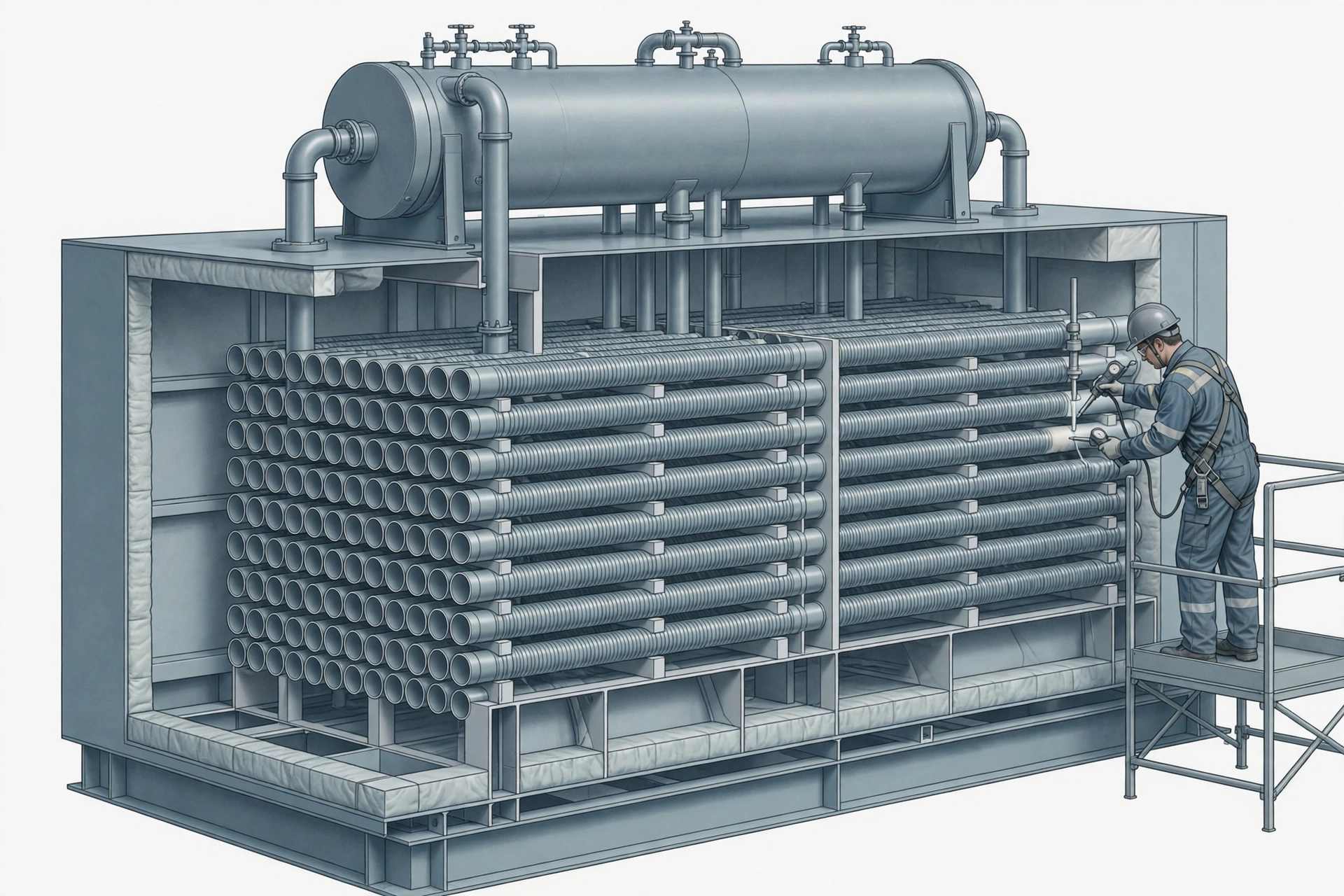
An HRSG opened up: tube banks under the drum, and the thickness measurements that build its biography.
How an Inspection Actually Runs
An HRSG inspection starts long before the scaffolding goes up. The outage window fixes the scope: with the unit cold and isolated, the inspection team — API 510 authorised inspectors for the pressure boundary — works through the pressure parts methodically. Visual examination comes first, inside and out, because the eye still finds things instruments miss: bowed or deformed tubes that speak of past overheating, displaced insulation, cracked welds at attachments, casing damage around expansion joints.
Then the instruments. Ultrasonic thickness measurement is the backbone of the whole exercise — hundreds of readings at fixed, recorded locations on tubes, headers and drums, compared against minimum thickness values. Suspect welds get dye-penetrant examination; boroscopes reach into headers and attemperators where no person can go; and where the history demands it, radiography checks the welds that thickness readings cannot. Every reading is recorded against its exact location, because a thickness number without a position is useless next year, when you need to read the same spot again and compute a rate.
And rate is the word that matters. A tube at ninety percent of its original thickness is not an emergency. A tube that has lost five percent of its thickness in each of the last three outages is. The inspection produces findings; the trending produces decisions — monitor, plan replacement, or act now.
The Findings That Matter
After enough of these inspections, you learn to sort findings into two piles. In the first pile: the routine, the trended, the known. Uniform thinning in a known location, stable over years — recorded, watched, budgeted for in a future outage. In the second pile: the things that change the plan. Cracked attemperator liners. Ligament cracking between tube holes in headers. Deformed tubes indicating an overheating event someone never documented. Oxide-scale exfoliation blocking the steam path. Evidence that corrosion rates have accelerated since the last outage — which almost always leads back to a chemistry question: what changed in the water treatment, the deaeration, the dosing?
That last point is worth underlining. A large fraction of HRSG damage is not metallurgy failing; it is chemistry being neglected. The pressure vessel is the victim and the water treatment plant is often the scene of the crime. Any inspection programme that does not tie its findings back to the chemistry records is doing half the job.
The Statutory Test: Pakistan Law, PSVs, and the Part That Cannot Be Outsourced
Alongside the engineering inspection sits a second, harder-edged obligation: the annual statutory test. In Pakistan, the governing law is the Boilers and Pressure Vessels Ordinance, 2002 — Ordinance No. CXXI of 2002. Section 6 prohibits an owner from using a boiler unless it is registered and unless a certificate or provisional order authorising its use is in force; it also prohibits use above the maximum pressure recorded in that certificate. Registration under section 7 is granted for a period not exceeding twelve months, and section 8 is the renewal route: the boiler is examined "as per approved applicable code" and, if in good condition, renewal is recommended to the Chief Inspector for a further period not exceeding twelve months. That is what turns the HRSG test into an annual appointment rather than a matter of preference.
The Ordinance also explains why third-party execution is normal. Its definition of "Inspection Authority" covers a Board-approved organisation other than the manufacturer and the user, including approved third-party inspection companies and insurance companies, authorised to carry out inspection at first registration and at the yearly inspection. In practice, we used a third party for much of this annual testing work — the examination and the witnessing. But outsourcing the hands does not outsource the accountability. Section 13 keeps the owner's duties at examination on the owner: prepare the boiler properly, provide facilities, and provide the information required. More importantly, the decisions remain the owner's decisions. What scope is opened, which findings are accepted, which defects are repaired before return to service, which are trended to the next outage, and whether the unit is fit to run for another certificate period — those calls carry the plant's liability, and they cannot be delegated to the inspector's stamp.
Nowhere is that clearer than in the pressure safety valves. A PSV is the last mechanical line between a control failure and an overpressure event, and the annual test is where you find out whether that line is real. The testing can be done offline or online, and the two methods answer different questions.
Offline testing is the complete examination. The valve is removed during the outage, tagged, and given an as-found pop test before cleaning or adjustment — the first lift tells you how it actually behaved in service, not how it behaves once made presentable. On the bench, inlet pressure is raised slowly against a calibrated reference gauge until the valve pops, and the test is repeated until the opening pressure is stable and repeatable. The checks are visual and functional together: nameplate and datasheet against the installed duty; inlet and outlet condition; seat and disc damage; spring condition; spindle and guide freedom; bellows condition where fitted; drain and vent paths clear; discharge line unobstructed, with no gag or closed isolation valve. The readings to record are the as-found set pressure, the adjusted set pressure if it is changed, the reseating pressure, and blowdown — the difference between set and reseat. If set pressure is out of tolerance, adjustment is made in small spring increments and proved again by popping, not assumed. After setting, seat tightness is checked below set pressure, commonly around ninety percent of set pressure or the manufacturer's specified simmer point: a valve that pops correctly but leaks in normal operation is still not fit, and persistent leakage after correct setting usually means seat damage to lap, repair or replace — not more spring force.
Online, or in-situ, testing keeps the valve on the vessel. One method is to raise system pressure towards the set point, but on an HRSG that is often the least attractive route: it disturbs the plant and may lift more than one valve. The better in-situ method uses a lift-assist device on the valve spindle while the system remains at operating pressure. The device applies a measured additional force, detects initial stem movement or simmer, and calculates the effective set pressure from the system pressure plus the assist force acting over the seat area. It confirms the valve is free to lift and its set point has not drifted badly, without removal or a full outage. Its limits must be respected: it does not prove full relieving capacity, blowdown and reseat are not demonstrated as on a bench, seat tightness is only partly inferred, and a valve that fails, sticks or leaks still has to come off.
Whether the test is online or offline, the parameters I want watched are the same. Set pressure against nameplate and datasheet, with drift from last year trended rather than merely passed or failed. Reseat pressure and blowdown: too little blowdown risks chatter and seat damage; too much wastes steam and can pull pressure down further than the process can afford. Behaviour on approach — clean pop, or simmer, flutter and hesitation. Seat leakage below set pressure, especially where normal operating pressure sits close to the set point. Back pressure at the discharge, because built-up and superimposed back pressure change how a conventional valve behaves. Temperature effect, because a valve set cold on a bench is being asked to protect a hot drum or superheater outlet, so cold differential test pressure belongs in the record. And finally, the unglamorous items that decide whether the certificate means anything: calibrated gauges of the right range, test medium recorded, seals restored after adjustment, and the as-found and as-left results filed where next year's engineer can find them.
The Takeaway
If I had to compress the whole discipline into one practical habit, it is this: never let an inspection end at the finding. Every HRSG inspection should finish with three things — the findings recorded at repeatable locations, the rates calculated against the vessel's history, and a dated decision for each significant one: replace this outage, plan for the next, or monitor on the next inspection. An inspection that produces a report is an expense. An inspection that produces dated decisions, tied to chemistry and trended against history, is how a pressure vessel quietly reaches its design life and keeps going — and how a maintenance manager sleeps through the night.
Further Reading
API 510, Pressure Vessel Inspection Code — new edition (API) — the American Petroleum Institute on the current edition of the code used throughout this post.
The Boilers and Pressure Vessels Ordinance, 2002 — official text (Pakistan Code) — the law itself: registration, the twelve-month certificate, renewal by examination, and the owner's duties at inspection.
More from the blog
 ProjectsHow Owners Evaluate Bids — Inside a Techno-Commercial EvaluationA bid that passes pre-qualification, a technical read of the method, prices normalised to one basis and a whole-life view may still not be the cheapest — but it will be the one you can defend, to a board, an auditor, and the plant that has to live with it.Read post →
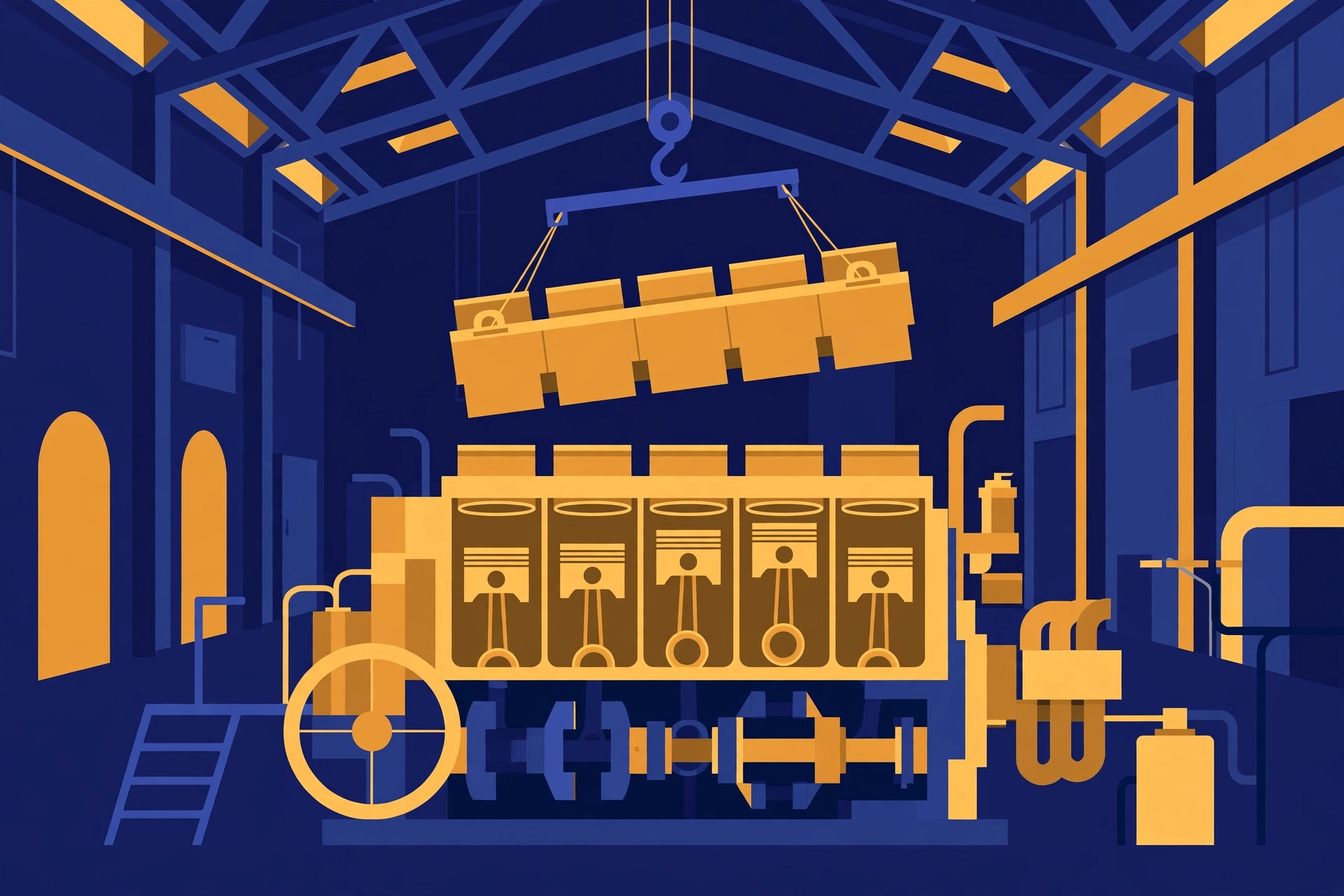 MaintenanceMinor at 30K, Major at 60K — The Rhythm of Engine OverhaulsAn engine wears out on hours, not dates. The 30,000-hour minor is a checkpoint whose measurements shape the 60,000-hour major — and across a 32-engine fleet, sequencing, spares and records are what make the programme work.Read post →
 EnergyWhy the Grid Struggles at 7 pm: Peak Demand, ExplainedThe evening peak is not a shortage of plants. It is a timing problem: demand climbs as solar falls away, and the system must ramp faster than its slowest plant can move — buying the last megawatts from the dear end of the merit order.Read post →