Projects
How Owners Evaluate Bids — Inside a Techno-Commercial Evaluation
How owners should evaluate bids: real pre-qualification, method over brochures, prices on one basis, whole-life cost — and NEPRA's EPC and O&M rules.

A bid that looks cheapest on opening day can turn out to be the most expensive contract an owner ever signs. I have sat on the evaluation side twice as an independent evaluator: once for the coal jetty operation and maintenance scope at CPHGC's 2 × 660 MW plant, and once for ash handling at Engro Powergen Thar's 660 MW plant. Different scopes, same lesson. The winning bid is rarely the one with the lowest number on the price schedule. It is the one that survives technical scrutiny and still makes commercial sense over the whole life of the contract.
The owner is buying years of performance, not a piece of equipment in a box. A jetty contractor who cannot keep coal moving will idle a 1,320 MW station; an ash contractor who cannot dispose of ash within its environmental conditions will stop a 660 MW plant just as surely. Price is one line. Availability, method, manpower, equipment condition and risk allocation are the rest.
The evaluation starts before the tender is issued
Most evaluations are won or lost before a single bid arrives, in the tender documents themselves. If the technical and commercial scoring criteria are not defined there — what scores, how much each part weighs, what counts as pass and what counts as fail — then the evaluation has no fixed ground to stand on, and every later decision becomes an argument.
Write the criteria into the tender, in numbers where scoring applies, and publish them to every participant on the same terms. A bidder who knows how it will be scored can bid to the criteria instead of guessing at them. That is the point of transparency: the same information, the same forms, the same scoring, for everyone. It is also what keeps an evaluation defensible. Pakistan's Public Procurement Rules, 2004, say it plainly — bids are evaluated only against criteria specified in the bidding documents, and no criterion that was not specified may be used (Rule 30). The same rules require the bidding documents to define the evaluation criteria clearly (Rule 21), and they give an aggrieved bidder a grievance redressal committee to complain to: against the criteria themselves before the submission deadline, and against the evaluation reports after (Rule 48). An owner who publishes clear criteria gets fewer complaints, because there is less to complain about. An owner who improvises criteria mid-evaluation invites exactly the conflict and legal challenge the process is meant to avoid.
The tender should also state, up front, what data a bidder must submit to take part — and in what form. Experience claims need evidence, not assertion: completion certificates, client references, contract values and dates, on predefined templates and forms that are part of the tender itself. When every bidder fills in the same form, the comparison becomes apple-to-apple instead of a contest between a detailed submission and a glossy one. A bidder that cannot produce the evidence for a claimed project has not met the requirement, whatever its brochure says. International practice points the same way: the World Bank's standard procurement documents require the bidding documents to specify the information and evidence each bidder must submit, along with the evaluation methodology and the weightings.
Ownership data belongs in the same package. Under Pakistan's Declaration of Beneficial Owners Information of Public Procurement Contract Awarded Regulations, 2022, public procurement contracts worth PKR 50 million and above must carry the company's beneficial ownership information, published on PPRA's website. Ask for it in the tender, not after award. Knowing who ultimately owns and controls a bidder lets the owner run a sanity check: does this company have the substance behind the submission, who stands behind it, and is anyone lobbying for it from inside the process? That check is worthless if it comes after the contract is signed.
Transparency is the thread through all of it. Criteria published, weights fixed, data required on standard forms, evidence demanded, ownership declared — before bids arrive. The stages that follow then do what they are supposed to do: apply rules everyone could see, instead of inventing them.
Start with pre-qualification, and mean it
Pre-qualification is where most weak bids should die. The question is narrow: has this bidder actually done work of this kind, at this scale, under comparable conditions? A contractor who has handled bulk material at a port is not automatically qualified to run a coal jetty feeding a power station, where a missed shipment window becomes a generation shortfall rather than a late delivery.
Financial standing belongs here too. A bidder that cannot fund mobilisation, spares and payroll through the first months will ask for advances, cut corners, or both. Criteria must be written before the bids arrive, then applied as written — criteria rewritten after opening tend to be rewritten in favour of a bidder someone already likes, and experienced bidders can tell.
Technical evaluation: read the method, not the brochure
The technical evaluation asks whether the bidder understands this specific job, or has pasted a generic method statement into a new cover page. The tells are concrete. Does the manpower plan name the shifts, the supervision structure and the standby cover, or does it promise "adequate staff"? Does the equipment list show machines the bidder owns or holds under firm hire, with ages and condition, or a fleet it hopes to arrange? Is there a maintenance plan for that equipment, or only a promise that it will be maintained?
For an O&M scope, the method statement should read like a week in the life of the contract: a normal day, a conveyor trip, a ship arriving early — who decides, and how fast. If a bidder cannot describe its own response to a breakdown, it has not thought about the job. It has thought about winning it.
Scoring helps only if the weights are honest and fixed before opening: score technical merit, experience and method heavily enough that a slick price cannot rescue a thin technical bid. Adjusting weights mid-evaluation to change the ranking means the evaluation has stopped being one. Deviations need the same discipline. Small ones get priced or accepted in writing; material ones — exceptions that change what the owner is actually buying — mean the bid is non-responsive. Never accept one silently and discover it during execution, when it has become a claim.
Commercial evaluation: price the whole life, not the first year
This is where the cheapest bid usually falls apart. Two bids for the same scope can differ in what is included, what is excluded, what escalates and when, and who carries the cost of failure. Comparing headline prices alone is comparing different things and calling it a comparison.
Whole-life cost is the corrective: the contract price plus the owner's retained risks — supervision, spares the owner must still hold, downtime under poor performance, and re-tendering if the contract fails early. A bid 10 percent cheaper that fails in year two is not cheaper. It is a re-tender, a mobilisation and degraded service, all priced on top of the saving.
Liquidated damages must be credible: a clause so high no bidder will sign it is theatre, and one so low a contractor can absorb it is a discount, not a deterrent. Tie it to the owner's actual loss — the generation, demurrage or disposal cost that follows from non-performance — and work it out before tendering, not after award, when leverage is gone. Currency, escalation and tax treatment need the same normalisation: bids on different bases cannot be ranked until they share one. Normalisation is tedious, and it is the difference between a ranking and a guess.
Clarifications are not negotiations
Clarifications exist to resolve genuine ambiguity: a missing certificate, an unclear rate, a scope boundary read two ways. They do not exist to let a bidder rewrite its price after seeing where it stands, or an owner bargain a preferred bidder down after competition has closed. The first corrupts the process; the second teaches every bidder the tender price is only an opening position.
Good practice is written and auditable: questions and answers in writing, the same information to every bidder still in contention where it affects scope or price. An evaluation that cannot show its working will not survive a challenge. Pakistan's framework points the same way: the Public Procurement Rules, 2004, define value for money as the best return for each rupee spent across quality, timeliness, reliability, after-sales service and whole-life cost — not the lowest price on the day.
What separates a winning bid from a compliant one
Compliance gets a bid into the room. Winning bids show the owner what the contract will actually feel like to live with: a method specific to this site, risks named rather than hidden in exclusions, and a price traceable to the method — so many people, so many machines, so much maintenance — rather than a lump sum taken on trust.
The weakest bids share a pattern: a long technical section and a short method section, a sharp price and sharper exclusions, an experience list that never says what the bidder actually did. None of that is fraud. All of it is a bidder asking the owner to carry risk the bidder has not priced. The evaluation is the one moment the owner holds all the leverage it will ever hold. Use it then, because after award, the contractor holds the plant.
The regulator's checklist: NEPRA's EPC and O&M selection guidelines
Pakistan's regulator has published the same discipline as a formal framework, and it is worth reading alongside the method above. Two NEPRA guidelines govern how generation companies select contractors: the Selection of Engineering, Procurement and Construction Contractor by Independent Power Producers Guidelines, 2017 (S.R.O. 350(I)/2017, 17 May 2017), and the Selection of Operation and Maintenance Contractors by Generation Companies Guidelines, 2021 (S.R.O. 210/2021, 16 February 2021). Both are attached as downloads at the end of this post.
The framework starts where this post started: with advertising and criteria in advance. The invitation must run in at least four national and two international newspapers of repute, on the company and the Relevant Agency websites, and on two international tendering websites, and bidders must be given at least fifteen working days to collect the documents. Pre-qualification comes first, judged by an Independent Consultant on eligibility, non-performance and chronic litigation history, professional competence with key staff and equipment, relevant experience, and financial capability. At least two bidders must pre-qualify; a single pre-qualified bidder needs the Relevant Agency's approval before the process proceeds.
Evaluation follows the two-envelope method. Technical and financial proposals arrive in one package in separate sealed envelopes; the technical envelope is opened first in the presence of the bidders' authorised representatives, and the financial envelope stays sealed until technical evaluation is complete. Technical evaluation is done without reference to price, against criteria and minimum points fixed in advance, and a proposal that does not conform or falls below the minimum is disqualified. Only technically qualified bidders have their financial proposals opened, again in front of representatives, and their technical scores carry forward.
The scoring is where the two guidelines are most useful to an owner writing a tender. Technical and financial scores are each out of 100, combined at 40% technical and 60% financial, and the highest combined ranking wins. On the EPC schedule, technical marks run: contractor experience and capability 30, design 10, construction planning and methods 20, electrical and mechanical equipment 15, construction schedule 20, health, safety and environment 5. On the O&M schedule, the balance shifts toward delivery: relevant experience, past performance and personnel capabilities 50, O&M planning and methods 30, health, safety and environment 5, local component 15. On both schedules the financial score gives 70 points to the lowest evaluated bid price, with the rest scored pro rata, plus 10 for financial strength, 15 for contract conditions, and 5 for the remaining financial factor. Price negotiation is permitted only with the winning bidder, openly and transparently, and a written record of the whole process — pre-qualification, tendering, evaluation, contract — must be maintained and made available to the Authority on request. Evaluation rests with the Independent Consultant, with the Relevant Agency and the Authority in approval and record roles. And where a generation company wants to do its own O&M, the O&M guidelines require its costs to be evaluated by an Independent Consultant and approved by the Authority, so that self-performance gets the same transparency and cost-efficiency test as a tendered contract.
Note the schedules carry a practical caveat: the EPC technical criteria are stated for a typical hydropower project, with project-specific changes permitted. The weights are a starting template, not a substitute for thinking about what the specific job rewards.
The Takeaway
Before a single bid is opened: fix the pre-qualification criteria and scoring weights in writing; require method statements covering a normal week and a bad week, rather than a capability list; normalise every price to the same basis before ranking; and work out the whole-life cost, including what failure would cost you. And do that work before the tender goes out, not after bids arrive: publish the criteria, the weights, the data requirements and the standard forms in the tender itself, and ask for ownership data up front — transparency before bids arrive is what makes the evaluation defensible afterwards. A bid that passes all of that may still not be the cheapest. It will be the one you can defend — to your board, to an auditor, and to the plant that has to live with it.
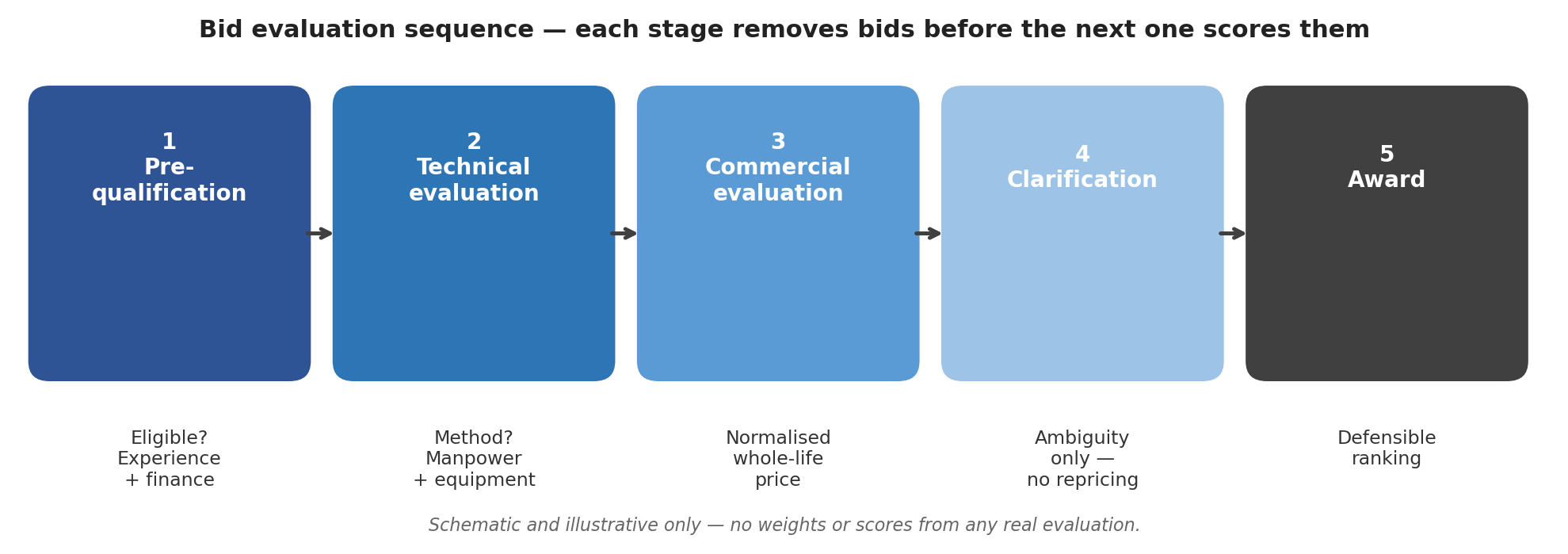
Figure: the bid evaluation sequence as described in this post, schematic and illustrative. Stages run in order — pre-qualification, technical evaluation, commercial evaluation (normalised to a common basis), clarification, award — and a bid that fails an earlier stage does not reach the later ones. No stage weights or scores from any real evaluation are shown.
Further Reading
Plant maintenance — pillar guide — The full maintenance guide, where O&M scope, inspection and the maintenance mix sit together.
Converting Open Cycle to Combined Cycle — Lessons from S&K Phase-II — The owner's side of a US$55M EPC conversion: design reviews, WHRSGs and commissioning discipline.
Public Procurement Rules, 2004 — PPRA — The Public Procurement Regulatory Authority's rules, including the definition of value for money across whole-life cost and quality, Rule 30 on evaluating only against criteria specified in the bidding documents, and Rule 48 on grievance redressal.
Declaration of Beneficial Ownership Information for Public Procurement Contracts — PPRA — The declaration form prescribed under the 2022 Regulations, under which public procurement contracts worth PKR 50 million and above must carry the company's beneficial ownership information, published on PPRA's website.
Rated Criteria in bid evaluation — World Bank — The World Bank's approach to rated (non-price) criteria: the bidding documents must clearly specify the information and evidence required from each bidder, along with the evaluation methodology and corresponding weightings.
Downloads
NEPRA — Selection of EPC Contractor by IPPs Guidelines, 2017 (PDF) — NEPRA publication (S.R.O. 350(I)/2017), hosted here for download; original on nepra.org.pk.
NEPRA — Selection of O&M Contractors by Generation Companies Guidelines, 2021 (PDF) — NEPRA publication (S.R.O. 210/2021), hosted here for download; original on nepra.org.pk.
More from the blog
 MaintenanceMinor at 30K, Major at 60K — The Rhythm of Engine OverhaulsAn engine wears out on hours, not dates. The 30,000-hour minor is a checkpoint whose measurements shape the 60,000-hour major — and across a 32-engine fleet, sequencing, spares and records are what make the programme work.Read post →
 EnergyWhy the Grid Struggles at 7 pm: Peak Demand, ExplainedThe evening peak is not a shortage of plants. It is a timing problem: demand climbs as solar falls away, and the system must ramp faster than its slowest plant can move — buying the last megawatts from the dear end of the merit order.Read post →
 MaintenanceVibration Analysis for Beginners: What the Spectrum Is Telling YouAn overall vibration number says how much a machine shakes, not why. The spectrum splits the shaking into frequencies — 1× for unbalance, 1× plus 2× with high axial readings for misalignment, a forest of harmonics for looseness, off-grid peaks for bearing defects — and phase settles the cases that look alike.Read post →