Maintenance
Minor at 30K, Major at 60K — The Rhythm of Engine Overhauls
A reciprocating engine wears out on hours, not dates. The 30,000-hour minor is a structured checkpoint whose measurements shape the 60,000-hour major — and across a 32-engine fleet, sequencing, spares and records are what make the programme work.
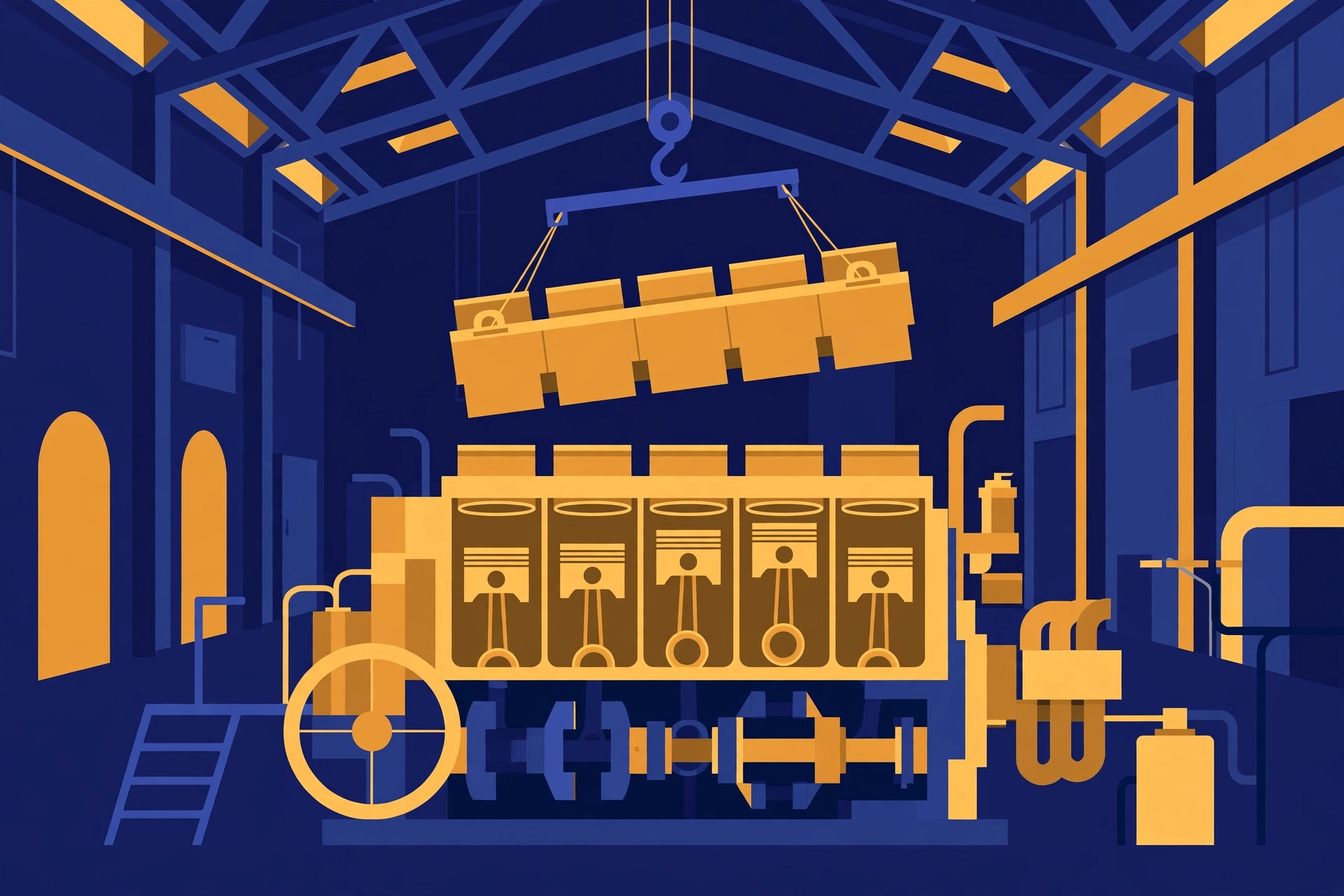
A reciprocating engine does not wear out on a date. It wears out on hours. That sounds obvious until you plan work around it, because hours arrive at different speeds on different engines, and a fleet of 32 engines never agrees on a convenient week to stop.
I learned the rhythm early, doing 30,000-hour minor overhauls on Jenbacher engines, and saw it at full scale when I planned, supervised and managed the 60,000-hour major overhaul of the complete 32-engine SGTPS fleet during 2019–2021.
Why hours, not the calendar
An engine's overhaul clock counts running hours, not months on a wall. Two identical engines can sit thousands of hours apart simply because one carried more load, or ran through a season the other missed. Plan by calendar and you open one engine too early, wasting good life, and another too late, after the wear you meant to catch has done its damage.
At continuous running, 60,000 hours is close to seven years. Few engines run that way, so the date moves — but the hour count still says how much work the machine has done. Start every plan from a forecast of hours, engine by engine.
Starts count too, not just hours. One of our own worklists put crankshaft main and thrust bearing replacement at 30,000 hours or 4,000 engine starts, whichever comes first. A start is a thermal and lubrication transient — cold oil, parts expanding at different rates, a short period before the oil film is fully established everywhere. An engine that starts and stops constantly can reach its bearing limit well before its hour limit. Any forecast that counts hours and ignores starts is half a forecast.
Wear is cumulative. Clearances open up, sealing worsens, combustion loosens, and the engine burns more fuel for the same output. It builds hour by hour, which is why a fixed-hour intervention makes sense: step in before slow decline becomes a forced stop.
The ladder: every interval contains the ones below it
The first thing to understand about overhaul scope is that the intervals nest. A bigger job does not replace the smaller schedules — it includes them. Our KGTPS worklists were written exactly that way, and the structure is worth spelling out because it is how you scope any overhaul without missing the routine work.
At 2,000 hours: valve clearance checked and adjusted, valve-stem projection measured, ignition system checked end to end (ignition point, cable harness, pickups, coils, plug connectors), oil filter cartridge changed, table cooler checked for clogging, gas train filter checked and leak-tested, generator bearings re-lubricated, crankcase ventilation differential pressure checked.
At 10,000 hours, everything above plus: core and flame-trap cleaning, pre-chamber and pre-chamber gas valve inspected and replaced if required, starter motor replaced, cooling-water pump mechanical seal replaced, throttle-valve rod ends replaced and lubricated.
At 20,000 hours, everything above plus: turbocharger overhauled with 20K kits, throttle-valve bearing and O-ring replaced, gas mixer circuit board replaced, and all elastomers — every O-ring on the pre-combustion chamber, cylinder head cover, spark plug extension, cooling water and oil lines, oil filter connection, oil pump and turbo compressor connection, plus oil hoses, rubber buffers and the intake bellows up to the compressor intake.
Rubber and seals are on a clock of their own. They harden and shrink with heat and age whether the engine ran or not, which is why a 20,000-hour job replaces them wholesale rather than waiting for each one to leak. A single failed O-ring can stop an engine as surely as a failed bearing, and it costs far less to replace it on plan than to find it at midnight.
The 30,000-hour minor and the 60,000-hour major then sit on top of this ladder. Neither is a standalone job. Both begin with everything below them already in scope, and add their own work on top.
What the minor at 30,000 hours is for
Think of the minor as a checkpoint halfway to the major. The engine is opened enough to inspect, measure and replace the parts that wear first, and to confirm the condition of the rest. It is not a rebuild. It is a structured look inside, with work done where the measurements say work is needed.
There is a design reason the minor sits at 30,000 hours: the crossflow cylinder head itself — individual heads per cylinder, mixture side separated from exhaust side — carries a service life of up to 30,000 operating hours in Jenbacher's own design description. At 30,000 hours the heads come off, get cleaned and inspected, and the question the minor answers is whether they go back on, get reconditioned, or get exchanged.
The classic finds at a 30,000-hour service tell you what the minor is hunting. Pre-combustion chamber pockets showing gas passing — the seal between chamber and head is letting combustion gas by, which shows up as rising coolant pressure and, left alone, as overheating. The remedy is mechanical and unglamorous: dismantle the head, re-cut the lower seat, lap it to a seal, pressure-test it, and refit with new flame rings and O-rings, torqued down on new studs. Exhaust bellows and flanges crack under thermal cycling and show up on pressure testing. Intercooler threads get damaged by earlier poor repairs. The exhaust damper seal fails and the damper stops closing properly. None of these is exotic. All of them are found by opening the engine and looking, which is the whole point.
From our own minor overhaul reports, the checklist runs: turbocharger overhauled and inspected for alignment and shaft balancing, bushes replaced, everything cleaned and refitted with new O-rings and gaskets, repair kits throughout; engine oil pump and mechanical oil pump; cooling system and pumps; oil cooler; filter elements and breather filter; compensator; oil pipes and ducts; cooling nozzles. And the bearing rule from the worklist: main and thrust bearings replaced at 30,000 hours or 4,000 starts.
The minor's value is information as much as repair. Measurements at 30,000 hours show how the engine is actually wearing, not how the manual assumed it would, and that record shapes the major. Skip the minor and the major becomes a guess.
Condition monitoring fills the gaps between overhauls. Oil, temperature, vibration and performance trends show whether an engine is tracking normally toward its next interval or heading there faster — and one trending wrong gets watched, sometimes pulled forward. The interval is the plan, not a promise.
What changes at the major
At 60,000 hours the job is different in kind. The engine comes apart properly: strip-down, inspection and measurement of the major components, reconditioning or replacement where measurements demand it, and a rebuild to specification. Clarke Energy, an authorised Jenbacher service provider, puts major overhauls for these engines at 60,000 or 80,000 operating hours depending on type and version, involving removal, strip-down, rebuild and reinstallation — the scale of the job at SGTPS, where 60,000 hours was the fleet's major.
What gets measured at a major is everything the minor only sampled. Cylinder liners for bore wear and scoring, pistons and rings (including the scraper ring that keeps carbon off the piston crown and oil consumption down), connecting rods, crankshaft journals and bearings, camshaft and valve train, vibration damper and flywheel, crankshaft seals. Cylinder heads, turbochargers and pumps are reconditioned to OEM standard rather than simply inspected. Parts that measure within tolerance go back; parts that do not are reconditioned or replaced. That measurement discipline is what separates a major from a large minor.
There are three ways to buy a major, and the choice is really about downtime. INNIO Jenbacher's own reUp programme offers it as a genset scope (complete engine plus alternator), a longblock (core engine plus other components) or a shortblock (core engine only), with an exchange option: order the replacement engine before yours goes back, so the outage is a swap rather than a rebuild. Independent overhaulers work the same way with exchange components — pre-overhauled cylinder heads and connecting rods delivered to site — and shortblock exchange instead of weeks of on-site revision. The process underneath is the same everywhere: inspect and examine, write a findings report, agree which components get exchanged, clean and repair what is reused, assemble, then leak-test and component-test before the engine goes back to load.
The economics push the same way. A high-quality rebuild typically runs 60–70% of the cost of a new engine, according to PowerUP's rebuild guide, while a new engine can carry a lead time of twelve months or more. The heavy cast parts — block, crankshaft, connecting rods — are built to last decades. You are paying to restore the wearing parts around them, not to replace the machine. And because a rebuild is usually classified as maintenance rather than a new asset, it can sit in a different budget line entirely — one more reason to plan it rather than have it forced on you.
A major resets the overhaul clock; it does not make the engine new. It restores clearances, sealing and condition to a known standard, so the next checkpoint starts from measurements you can trust. Done late, it becomes a repair job, with the extra cost and downtime that always brings.
Minor versus major, side by side
| Minor (30,000 h) | Major (60,000 h) | |
|---|---|---|
| Strip-down | Heads off, opened enough to inspect and measure | Full strip-down, engine removed if required |
| Cylinder heads | Cleaned, inspected, re-cut and lapped where needed, or exchanged | Reconditioned to OEM standard or exchanged |
| Pistons and liners | Inspected, measured; replaced only where measurements demand | Measured throughout; rings, liners and pistons replaced or reconditioned as required |
| Bearings | Main and thrust bearings replaced (30,000 h or 4,000 starts) | Full bearing set measured and replaced; crankshaft journals checked |
| Turbocharger | Overhauled, alignment and shaft balancing checked | Reconditioned to OEM standard |
| Pumps and cooling | Oil and cooling pumps, oil cooler, filters, nozzles serviced | Pumps reconditioned; cooling system fully checked |
| Ignition and gas train | Checked end to end; gas mixer board replaced at 20,000 h | Full check and replacement of worn items |
| Elastomers | All O-rings, hoses, buffers and bellows replaced | All replaced again as part of the rebuild |
| Testing | Pressure tests on heads and exhaust; run-up and load test | Leak and component testing; full re-commissioning |
| Outcome | A measured engine with a known path to the major | A rebuilt engine with the overhaul clock reset |
The fleet problem: 32 engines, one station
One engine's overhaul is a job; 32 is a programme. SGTPS and KGTPS are 100 MW stations with 32 Jenbacher J620 engines each — you cannot take a fleet down at once and still call it a power station. Engines must come out, get overhauled, and go back in tested, while the station keeps running.
Sequencing is where most programmes succeed or fail, and it has little to do with spanners. You need the hours forecast first, the scope locked before the first engine stops, and spares on site before opening — a long-lead part can hold an engine longer than the overhaul itself. And the station's load must stay covered at every step. Exchange components and shortblock swaps earn their keep here: when the outage window is the constraint, swapping a pre-overhauled head or a shortblock beats rebuilding in place, and the programme keeps moving.
The discipline is boring and it is the whole job: same scope, measurements and records, engine after engine. That consistency lets you compare engines and spot one wearing faster than its sisters. Without a common record, a fleet programme is just 32 separate jobs sharing a site.
What happens when the rhythm slips
Deferring an overhaul rarely looks like a decision — a busy month, a tight budget, a station that cannot spare the engine. But the engine does not wait: wear accumulates, efficiency slides, and the eventual stop is longer and less controlled than the planned one. The saving was in this year's budget; the cost lands in next year's availability.
The other slip is losing the record. If minor measurements are not kept against the right engine, the major starts blind. I ran a plant-level SAP PM implementation earlier in my career because that record — functional locations, equipment hierarchy, work orders against the right machine — turns individual jobs into a history you can plan from.
The Takeaway
Work the ladder, not just the headline interval: the 2,000- and 10,000- and 20,000-hour schedules are inside every minor and major, and skipping them to save a day is how small defects survive into big jobs. Keep three lists current: engines ranked by hours to their next overhaul, the scope and spares for each job, and the sequence that keeps the station available. Check the hours forecast monthly — a plan built on last year's forecast is already out of date. Decide exchange versus rebuild before the engine stops, not during the outage. Get the minor right and the major stops being a gamble; get the sequence right and a 32-engine programme feels like steady work, not a crisis.
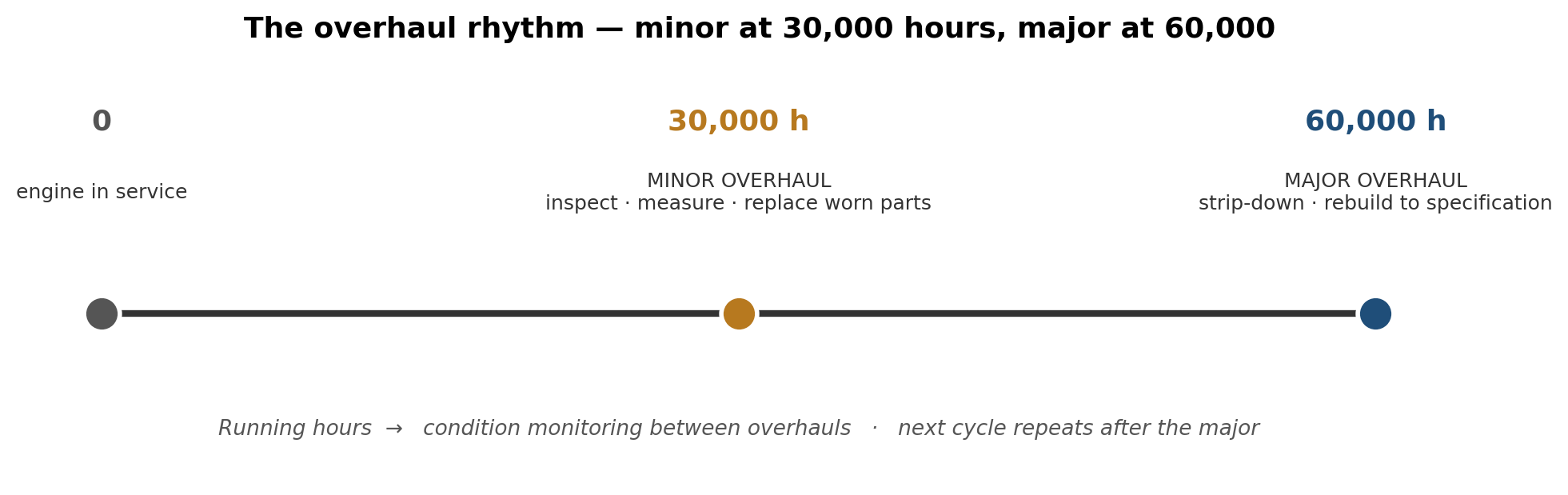
Figure: the overhaul rhythm for a reciprocating gas engine, schematic. A minor overhaul at 30,000 running hours, a major overhaul at 60,000. Intervals are those described in this post for the SGTPS Jenbacher fleet; Clarke Energy notes major overhauls at 60,000 or 80,000 hours depending on engine type and version.
Further Reading
Plant maintenance — pillar guide — The full maintenance guide, where overhaul planning, inspection levels and the maintenance mix sit together.
Planning a 60,000-Hour Overhaul Without Losing the Plant — The SGTPS fleet overhaul in detail: scope, spares, sequencing, and keeping a station available while its engines are opened.
Overhaul & Repair — INNIO Jenbacher | Clarke Energy — Authorised Jenbacher service provider's description of major overhauls at 60,000 or 80,000 hours depending on engine type and version, and what a major overhaul involves.
Jenbacher reUp Engines — INNIO Jenbacher's own major overhaul programme: genset, longblock and shortblock scopes, and the exchange option.
Gas Engine Overhaul — Jenbacher & MWM | PowerUP — Independent overhauler's overhaul process (inspection, findings report, exchange components, testing) and rebuild economics.
More from the blog
 ProjectsHow Owners Evaluate Bids — Inside a Techno-Commercial EvaluationA bid that passes pre-qualification, a technical read of the method, prices normalised to one basis and a whole-life view may still not be the cheapest — but it will be the one you can defend, to a board, an auditor, and the plant that has to live with it.Read post →
 EnergyWhy the Grid Struggles at 7 pm: Peak Demand, ExplainedThe evening peak is not a shortage of plants. It is a timing problem: demand climbs as solar falls away, and the system must ramp faster than its slowest plant can move — buying the last megawatts from the dear end of the merit order.Read post →
 MaintenanceVibration Analysis for Beginners: What the Spectrum Is Telling YouAn overall vibration number says how much a machine shakes, not why. The spectrum splits the shaking into frequencies — 1× for unbalance, 1× plus 2× with high axial readings for misalignment, a forest of harmonics for looseness, off-grid peaks for bearing defects — and phase settles the cases that look alike.Read post →