Maintenance
Planning a 60,000-Hour Overhaul | Without Losing the Plant
How the 60,000-hour major overhaul of a complete 32-engine Jenbacher fleet at a 100 MW station is planned and sequenced: programme structure, per-engine scope from condition, spares discipline, sequencing against grid obligations and recommissioning — by the engineer who managed it at SGTPS.

Sixty thousand hours. Run an engine continuously, day and night, and that is nearly seven years of its life. When a gas engine reaches that mark, you are no longer doing maintenance in any ordinary sense. You are preparing to open the machine to its bones and rebuild its working heart. At SGTPS, one of K-Electric's two gas-engine stations, I planned, supervised and managed exactly that programme for the complete fleet: all 32 Jenbacher J620 engines, at a 100 MW station that was expected to keep behaving like a power plant while its engines were taken apart.
That tension — rebuild everything, interrupt nothing — is what makes a fleet overhaul a management problem as much as a mechanical one.
What a 60K Overhaul Actually Involves
On a large gas engine, the manufacturer's maintenance schedule builds in stages: routine services, minor overhauls around the 30,000-hour mark, and the major overhaul at 60,000 hours. The major is a different animal. Pistons, liners and cylinder heads come out. Connecting rods and bearings are renewed or reconditioned. The crankshaft is inspected and measured. Turbochargers are overhauled or exchanged. Coolers, pumps and the ignition and control systems are gone through end to end. When the engine goes back together, almost every wearing surface inside it is new or restored. That is the point: you are buying the machine its next 60,000 hours.
Doing that once, on one engine, is a serious job. Doing it 32 times, on a live station, is a programme.
A Fleet Is Not 32 Separate Jobs
The first decision is to refuse to treat the overhaul as 32 independent projects. A fleet programme pools everything that can be pooled. Common overhaul kits and consumables are ordered in bulk. Reconditioning loops for cylinder heads and turbochargers mean a serviced unit is always coming back as the next one goes out. One specialist crew's hands learn the engine better with every unit. And one documentation system makes engine number thirty-two benefit from everything engines one to thirty-one taught you.
The second decision is subtler: scope is set per engine, not by template. Two engines with identical hours can be in very different condition, depending on how they were loaded, the gas they burned, and what their history files say. Oil analysis trends, borescope inspections, compression and blow-by behaviour, past findings — the scope for each engine is built from its own evidence, with the manufacturer's schedule as the floor, not the ceiling. Uniform scope is administratively tidy and technically lazy.
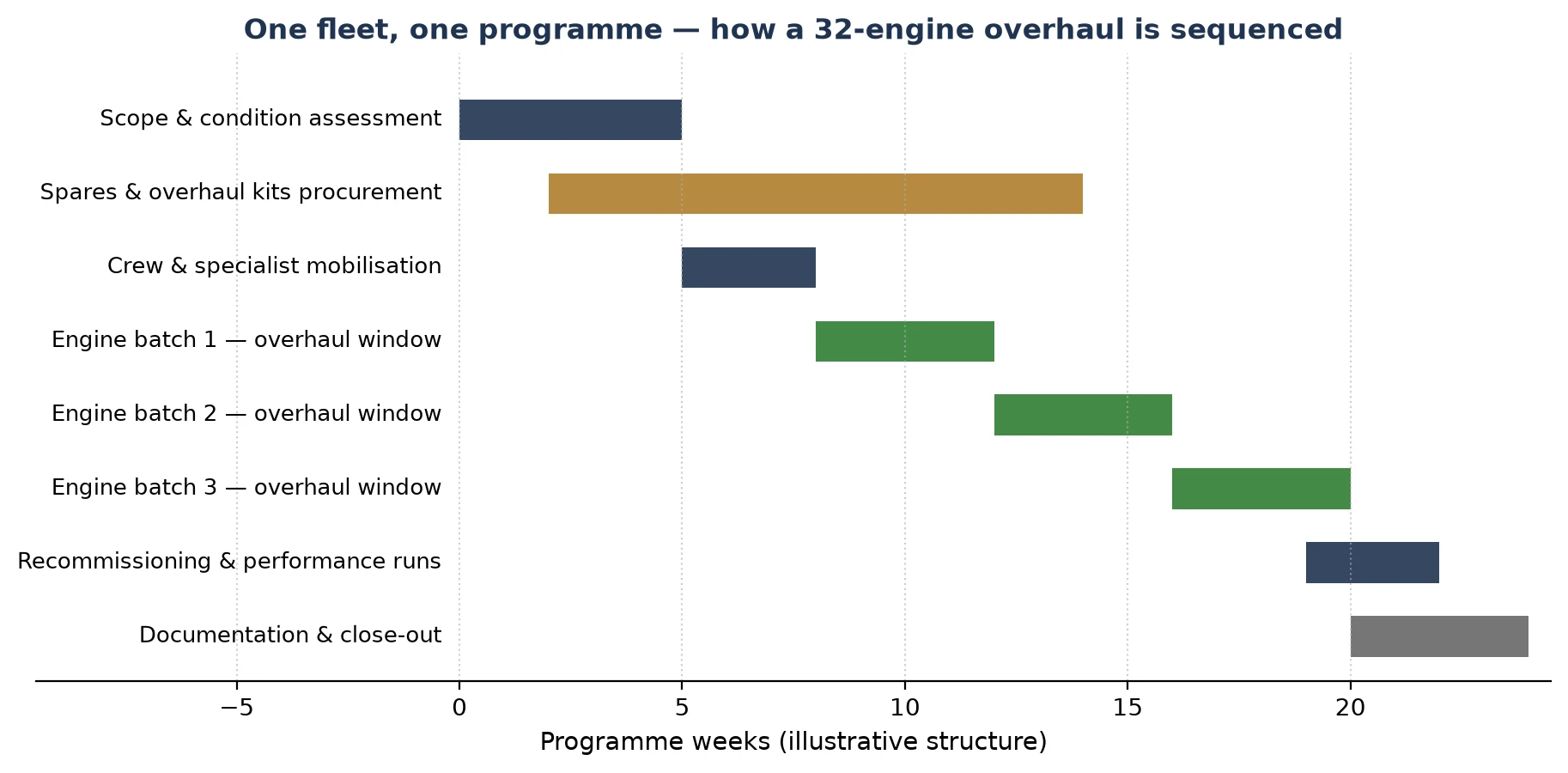
One fleet, one programme — the phases overlap so the station never stops for the overhaul; the overhaul fits around the station.
Sequencing Against the Station's Obligations
A power station cannot simply close for maintenance. The grid takes what it needs, and the station's availability commitments do not pause because an engine is in pieces. So the overhaul is cut into batches — a few engines at a time, never more than the station can spare — and the batch calendar is built backwards from the station's obligations, not forwards from the workshop's convenience.
This sequencing is where the programme is truly managed. Batches are arranged so that no two engines sharing a common system are down together. The learning curve is exploited deliberately. The first batch is scheduled with the most schedule slack, because it will teach the crew the most. By the third batch, durations tighten on evidence rather than optimism. And float is protected ruthlessly: a findings surprise on one engine (and there is always at least one) must not be allowed to cascade into the station's dispatch.
Spares: The Long Pole in the Tent
Ask overhaul managers what actually delays programmes, and few will say labour. It is parts. Overhaul kits, bearings, a liner that fails inspection and was not in the kit — procurement lead times run in months, and an engine standing open waiting for a component is pure loss. The bay is blocked, the crew is idle, and the station is an engine short.
The discipline that prevents it is unglamorous. The bill of material per engine is frozen early. Condition-based extras are pre-positioned for the failures experience says are likely. Exchange pools keep reconditioned components flowing. And every batch's parts are physically verified on the shelf before the first bolt is loosened — not promised, not in transit, on the shelf.
People, Cleanliness and Hold Points
Engines are assembled, not merely bolted. Bearings and crankshafts forgive nothing: a fingerprint of grit in the wrong place becomes a scored journal thousands of hours later. So the programme runs on craft discipline — controlled cleaning, measured torques recorded engine by engine, inspection hold points that nobody waives under schedule pressure, and supervision that treats a signed checklist as evidence rather than paperwork. Heavy lifts, stored energy and hot work sit inside the station's permit system throughout. An overhaul that hurts somebody has failed regardless of its schedule.
Coming Back: Recommissioning Is Part of the Overhaul
An overhauled engine is not finished when it is assembled. First starts are cautious, instrumented events. Load is built in stages. Temperatures, pressures, vibration and performance are recorded against the engine's own pre-overhaul baseline. Only when the machine proves itself under load does it return to the fleet — and its complete file, every measurement and finding, becomes the starting evidence for the next cycle, decades of machine memory built one overhaul at a time.
The Takeaway
A fleet overhaul succeeds on three disciplines. Run it as one programme, not thirty-two projects. Build every engine's scope from its own condition, not a template. And protect the station's output first — because the overhaul exists to serve the plant, never the other way round. Get those right, and 60,000 hours stops being a cliff edge. It becomes what it should be: a planned renewal, executed while the lights stay on.
Related tools and reading: Bolt Torque & Preload Calculator · Alignment Shim Calculator · Sling Tension Calculator · Thermal Expansion Calculator. · Plant Maintenance: The Complete Guide
Further Reading
Jenbacher J620 gas engine (INNIO Jenbacher) — the manufacturer's page for the engine at the centre of the SGTPS fleet.
Saad Hafeez is a Chartered Mechanical Engineer and Deputy General Manager – Power Plants at OMS. As Manager Maintenance at K-Electric he planned, supervised and managed the 60,000-hour major overhaul of the complete 32-engine fleet at SGTPS.
More from the blog
 ProjectsHow Owners Evaluate Bids — Inside a Techno-Commercial EvaluationA bid that passes pre-qualification, a technical read of the method, prices normalised to one basis and a whole-life view may still not be the cheapest — but it will be the one you can defend, to a board, an auditor, and the plant that has to live with it.Read post →
 MaintenanceMinor at 30K, Major at 60K — The Rhythm of Engine OverhaulsAn engine wears out on hours, not dates. The 30,000-hour minor is a checkpoint whose measurements shape the 60,000-hour major — and across a 32-engine fleet, sequencing, spares and records are what make the programme work.Read post →
 EnergyWhy the Grid Struggles at 7 pm: Peak Demand, ExplainedThe evening peak is not a shortage of plants. It is a timing problem: demand climbs as solar falls away, and the system must ramp faster than its slowest plant can move — buying the last megawatts from the dear end of the merit order.Read post →