Maintenance
Inside an LM6000 Hot-Section Exchange
Inside a hot-section exchange on a GE LM6000 aeroderivative gas turbine: why the modular design changes everything, what the hot section endures, how the outage is scoped by borescope evidence, and the proving runs that close it — from Level-3 maintenance managed at Korangi Power Complex.
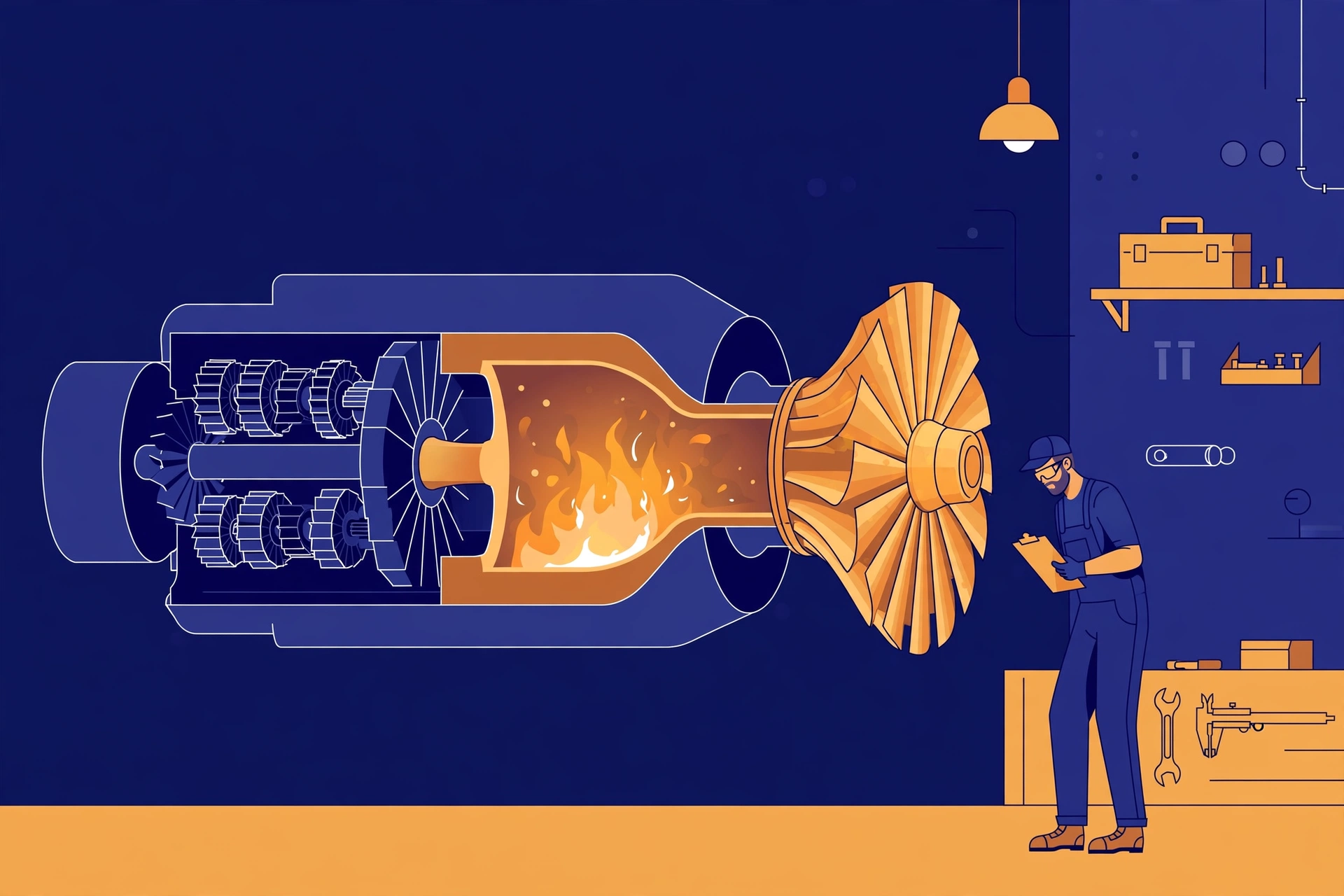
Sooner or later, the borescope settles it. The combustor liners are cracked beyond limits, the first-stage nozzle vanes are burned back, the turbine blades have lost their coating — and the machine the whole station plans around needs its hot section renewed. On the four GE LM6000 turbines at Korangi Power Complex, that work came under my watch as Manager Maintenance, as part of the Level-3 maintenance we carried out on those machines, including hot-section exchange and high-pressure compressor blade replacement.
The LM6000 makes this moment easier to handle than most turbines do — if you know what kind of machine it is.
An Aircraft Engine That Came Down to Earth
The LM6000 is an aeroderivative: a jet engine adapted to drive a generator. That heritage is no piece of trivia. It sets the whole maintenance philosophy. Aircraft engines aren't rebuilt in place on the wing. They're built in modules, taken off in modules, and overhauled in specialist shops while a replacement module keeps the aircraft flying. The LM6000 works the same way. Its major sections — low and high-pressure compressors, combustor, high-pressure turbine, low-pressure turbine — come apart as modules, and a lot of serious maintenance is really module management: the affected module comes out, an overhauled or serviceable module goes in, and the one that came out goes away for the slow, careful work it actually needs.
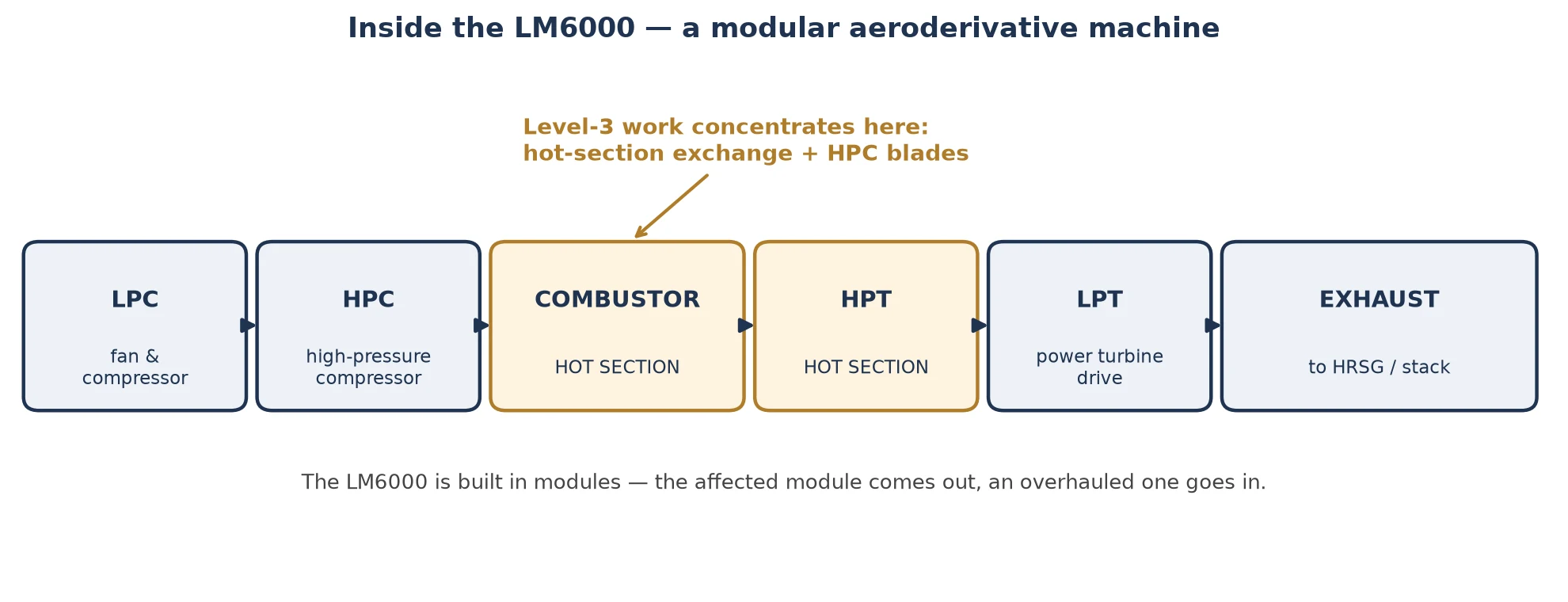
The aeroderivative layout: gas flows left to right, and the hot section — combustor and high-pressure turbine — takes the punishment.
What the Hot Section Actually Is
The hot section is where the machine earns its money, and pays for it. In the combustor, fuel and compressed air burn at temperatures that would soften the very metals containing them. The gas then hits the first turbine stages at full force. The components there — combustor liners, transition pieces, nozzle guide vanes, first-stage blades — live with thermal fatigue, oxidation, creep and coating loss, cooled by fine air passages that can block up themselves. Nothing else in the engine ages that fast. That's why hot-section work is scheduled by fired hours and starts, watched through borescope inspections, and never improvised.
An exchange, rather than a repair in place, is the call when the findings show the damage is general. The module comes out as a unit and an overhauled one goes in, putting the turbine back in service in days instead of the weeks a piece-by-piece rebuild would take. For a combined cycle plant, that decision is worth real money both ways. The module and its shop overhaul cost a lot. So does every day a 48 MW block stands silent, with its steam turbine and HRSG idle behind it.
The Work Around the Work
Visitors think the exchange itself is the hard part. It's heavy, precise and unforgiving — lifting plans, split-line bolts torqued in sequence, clearances checked — but it rarely decides the outage. Everything around the mechanical swap does that.
First, evidence. Borescope findings and performance trends (exhaust gas temperature spread and margin are the hot section's regular confession) set the scope before the machine is opened, so the replacement module and every consumable are on site before the shutdown starts. Second, the interfaces. An LM6000 doesn't live alone — fuel, lube oil, water wash, controls, fire protection and the exhaust path into the HRSG all have to be isolated, drained, disconnected, and later restored and proven. Third, the neighbours. At Korangi the turbine sits inside a combined cycle block, so the outage plan is written for the block — steam side, HRSG and auxiliaries scheduled into the same window. Taking the same unit down twice for separate jobs is the one waste you can't afford.
And when the scope includes the high-pressure compressor — blade replacement, as we carried out — the same discipline applies ahead of the combustor: rotor handling, blade-by-blade inspection and locking, and clearance checks that protect the machine's efficiency as much as its integrity. A compressor that leaks internally taxes every hour the turbine runs afterwards.
Proving It Afterwards
An exchanged hot section proves itself on the runs that follow. First fire is a careful business: leak checks, vibration watched channel by channel, exhaust temperature spread compared against the pre-outage signature, and output and heat rate checked against what the machine should now deliver. The borescope goes back in at the first chance to confirm the new hardware is bedding in as it should. Only then does the outage close — with the removed module's shop report, when it arrives, feeding its findings back into the maintenance plan for its three sister machines, which will each reach the same moment in their turn.
The Takeaway
A hot-section exchange isn't really a repair. It's the aeroderivative bargain, kept. You accept components that live fast and die young, and in return you get a machine that can be renewed in days by swapping modules instead of being rebuilt over months. But the bargain only pays off if the disciplines around it hold: inspection evidence that scopes the work early, logistics that have everything on site before the shutdown, and proving runs that close the loop. The module swap is the visible act. The management around it is the maintenance.
Related tools and reading: GT Ambient Derate Calculator · Degradation Tracker · Vibration Severity Evaluator.
Further Reading
LM6000 aeroderivative gas turbine (GE Vernova) — the OEM's page for the machine — ratings, configurations and operating profile.
Saad Hafeez is a Chartered Mechanical Engineer and Deputy General Manager – Power Plants at OMS. As Manager Maintenance at K-Electric's Korangi Power Complex he was responsible for Level-3 maintenance of its LM6000 gas turbines, including hot-section exchange and HPC blade replacement.
More from the blog
 ProjectsHow Owners Evaluate Bids — Inside a Techno-Commercial EvaluationA bid that passes pre-qualification, a technical read of the method, prices normalised to one basis and a whole-life view may still not be the cheapest — but it will be the one you can defend, to a board, an auditor, and the plant that has to live with it.Read post →
 MaintenanceMinor at 30K, Major at 60K — The Rhythm of Engine OverhaulsAn engine wears out on hours, not dates. The 30,000-hour minor is a checkpoint whose measurements shape the 60,000-hour major — and across a 32-engine fleet, sequencing, spares and records are what make the programme work.Read post →
 EnergyWhy the Grid Struggles at 7 pm: Peak Demand, ExplainedThe evening peak is not a shortage of plants. It is a timing problem: demand climbs as solar falls away, and the system must ramp faster than its slowest plant can move — buying the last megawatts from the dear end of the merit order.Read post →