Tariffs
Heat Rate | The Number That Decides a Plant's Tariff
Heat rate explained as the number that decides a thermal plant's economics: how benchmark heat rates work in regulated tariffs, what actually moves efficiency, the part-load penalty, and how heat rate is argued in a tariff petition — from the technical lead of K-Electric's six-station MYT case.

If you could watch only one number to judge a thermal power plant, it shouldn't be megawatts. Megawatts are the plant's promise. Heat rate is its character. Heat rate states, in a single figure, how much fuel energy the plant must burn to deliver one unit of electricity — and because fuel is the largest cost in thermal generation, that one figure quietly decides whether the plant makes money or loses it, whatever the dispatch chart says.
I've spent years on both sides of that number: running plants whose heat rate I was responsible for protecting, and building the technical case for K-Electric's Multi-Year Tariff petition, where the heat rates and operating costs of six generating stations had to be presented to NEPRA in a form the regulator could test.
The Arithmetic Nobody Escapes
Strip away the jargon and heat rate is brutally simple. Burn fuel containing a thousand units of energy and deliver four hundred units as electricity, and the plant has converted at forty percent efficiency. Everything else — every auxiliary motor, every leaking valve, every fouled compressor — is a tax collected between those two numbers.
Now put that plant under a regulated tariff. Tariffs don't reimburse whatever fuel a plant happens to burn; they allow fuel cost against a reference — a benchmark heat rate the regulator accepts as what a competently run plant should achieve. Burn at or better than the benchmark and the fuel cost is covered. Burn worse, and the difference doesn't vanish. It comes out of the owner's margin, megawatt-hour after megawatt-hour, year after year. A deterioration of even one or two percent — barely visible in daily operations, easily lost in the noise of a control room trend — compounds into sums that dwarf most maintenance budgets. That's why chief executives who've never tightened a bolt learn to ask about heat rate.
What Actually Moves It
Heat rate isn't a dial; it's the sum of a hundred small fidelities. Compressor fouling in a gas turbine strangles airflow and is repaid with water washes and, eventually, overhauls. Turbine blade degradation and worn seals leak efficiency continuously and silently. In the steam cycle, condenser vacuum, feedwater heating and HRSG condition each take their share. Ambient temperature taxes every air-breathing machine, which is why a Karachi summer shows up in the fuel bill as surely as in the weather report.
And then there's the factor operators control least and suffer most: load. A thermal plant is designed around its best point, and efficiency falls away on either side of it. Run a combined cycle plant at half load and its heat rate worsens sharply — the same fuel overhead spread over fewer units. A plant can therefore be mechanically excellent and thermally mediocre in the same month, purely because of how it was dispatched.
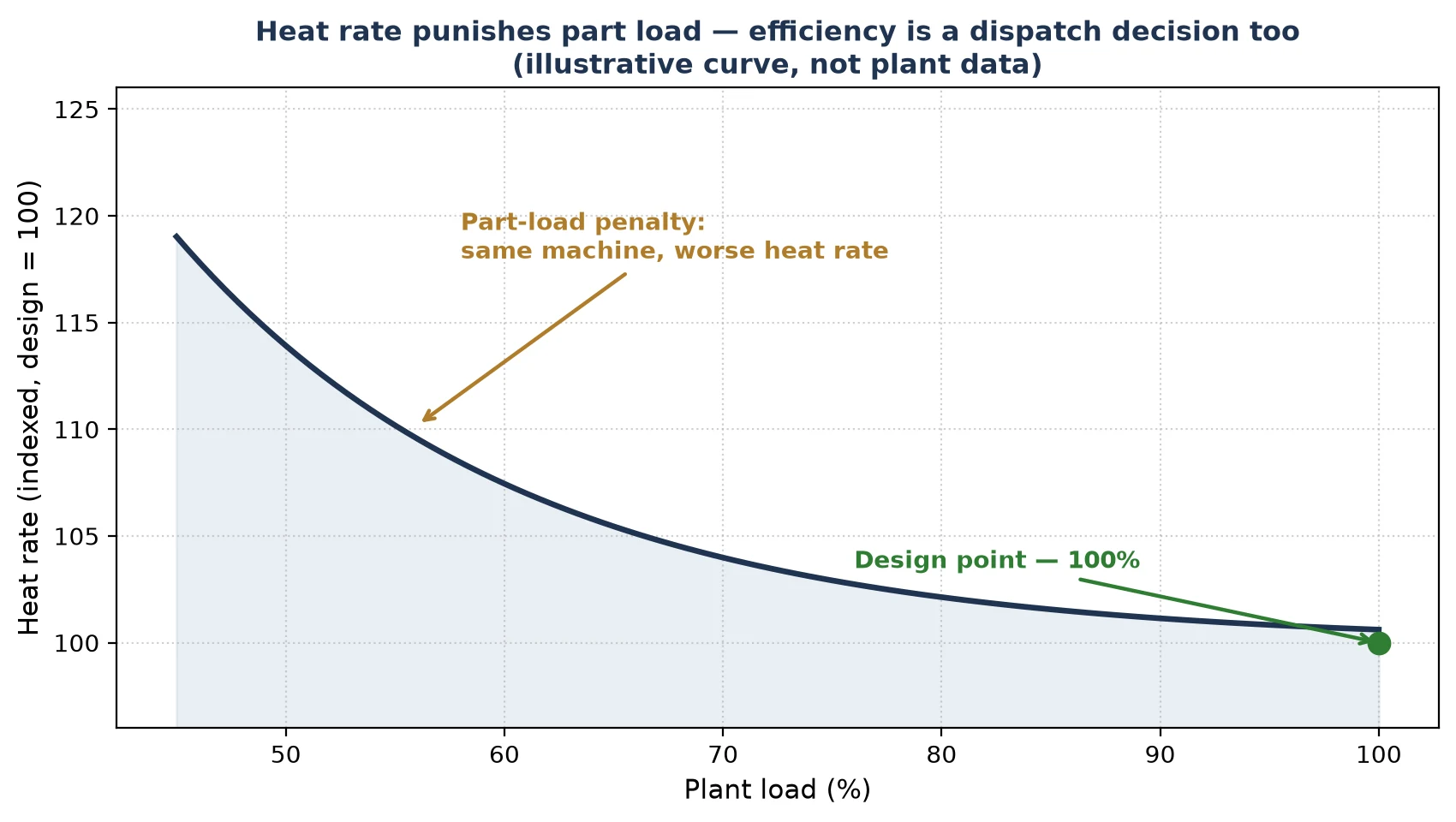
Heat rate against load — the design point is kind; part load is not. Illustrative curve, not plant data.
This is also why heat rate can't be managed from a monthly fuel report. By the time the number is printed, the fuel is ash and exhaust. It has to be tracked the way the plant actually lives — against corrected baselines, machine by machine, with deviations investigated while they're still small enough to be cheap. And those baselines only deserve the name if they were established by proper measurement; an uncorrected control-room figure is an opinion, and tariffs aren't settled on opinions. Performance testing exists precisely to replace opinion with evidence.
Arguing Heat Rate in a Tariff Petition
In a tariff proceeding, heat rate stops being an internal engineering metric and becomes evidence under cross-examination. The regulator's question is never "what did you achieve?" in the abstract; it's "what should a prudent operator achieve, on this plant, at this age, in this climate — and why is your number different?" Answering that takes more than test results. It takes the plant's whole biography: its test history, its degradation and the maintenance that answered it, the ambient and loading realities it operates under, and the investment case for closing whatever gap remains.
Building that case for six stations taught me the symmetry of the exercise. The same engineering that protects heat rate on the floor — clean compressors, honest baselines, evidence kept for years — is the engineering that defends it in the hearing room. Plants that treat performance as a maintenance topic alone discover, at tariff time, that it was always a commercial one.
The Takeaway
Heat rate is where engineering and money meet without any translation layer. Protect it with the unglamorous disciplines — washing, testing, trending, honest baselines — and argue it with evidence when the tariff is set. A plant's megawatts get the attention. Its heat rate decides whether the attention was worth paying for.
Related tools and reading: Heat Rate & Efficiency Converter · Fuel Flow Calculator · Performance Correction Calculator · Degradation Tracker. · Performance Testing: The Complete Guide
Further Reading
CPPA-G — Central Power Purchasing Agency (Guarantee) Ltd — the market operator that purchases power on behalf of the distribution companies — the other end of the tariff chain this post describes.
Saad Hafeez is a Chartered Mechanical Engineer and Deputy General Manager – Power Plants at OMS. He was the technical lead for K-Electric's Multi-Year Tariff petition covering all six of its generating stations.
More from the blog
 ProjectsHow Owners Evaluate Bids — Inside a Techno-Commercial EvaluationA bid that passes pre-qualification, a technical read of the method, prices normalised to one basis and a whole-life view may still not be the cheapest — but it will be the one you can defend, to a board, an auditor, and the plant that has to live with it.Read post →
 MaintenanceMinor at 30K, Major at 60K — The Rhythm of Engine OverhaulsAn engine wears out on hours, not dates. The 30,000-hour minor is a checkpoint whose measurements shape the 60,000-hour major — and across a 32-engine fleet, sequencing, spares and records are what make the programme work.Read post →
 EnergyWhy the Grid Struggles at 7 pm: Peak Demand, ExplainedThe evening peak is not a shortage of plants. It is a timing problem: demand climbs as solar falls away, and the system must ramp faster than its slowest plant can move — buying the last megawatts from the dear end of the merit order.Read post →