Maintenance
Running a Gas-Engine Fleet | Availability Is a System, Not a Spare Part
Fleet availability is a system, not a spare part — one overhaul calendar, one standard way of working, one honest record per engine, one shared spares pool.
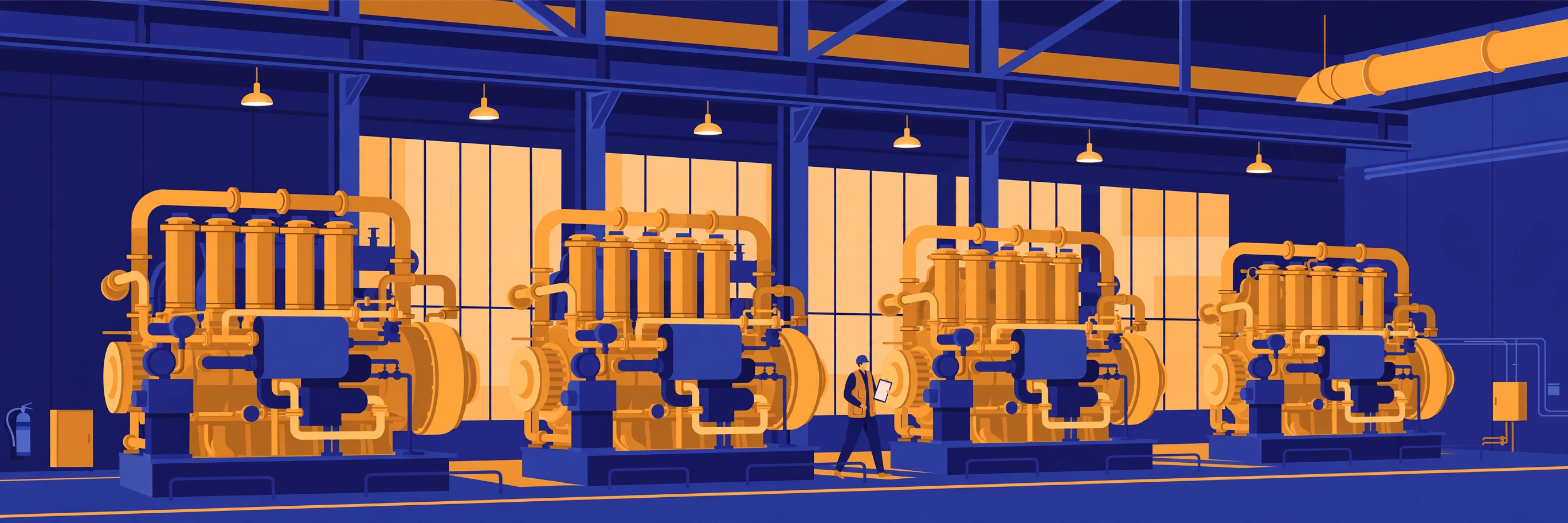
Walk into an engine hall with thirty-two gas engines in a row, and the scale hits you first. One engine is a machine you maintain. Eighty-six engines — thirty-two each at K-Electric's SGTPS and KGTPS stations, and twenty-two more across four plants at Omni Group — are a system you operate. Fleet availability doesn't live in any single engine. It doesn't live in any single spare part either. It lives in the routines that hold all of them together.
One engine is a machine; a fleet is a system
A single engine rewards good hands. A fleet rewards good organisation. With dozens of the same engine family — Jenbacher J620s, in my case — a fault on one unit is rarely a one-off. More often, it's a warning about the others. And it works the other way too: a fix that works on one engine, properly recorded, can be applied across the fleet before the same failure shows up elsewhere.
That's the first shift a fleet forces on you. You stop asking only "what is wrong with this engine?" and start asking "what does this failure tell me about the fleet?" The second question is worth far more. It lets you prevent the next failure instead of merely repairing this one.
The calendar is the backbone
Nothing shapes fleet availability more than the overhaul calendar. A reciprocating engine lives by its running hours. Minor overhauls come at around 30,000 hours — work I did early in my career at K-Electric. Major overhauls come at 60,000 hours, which I later planned, supervised and managed across the complete thirty-two-engine SGTPS fleet.
But the calendar only works as a station plan, not as a list of engine dates. Engines can't all come down at once. They can't all be left running until they demand attention together, either. Sequencing is the work: which units come out, in what order, with what spares and what crew — and how the station keeps generating while its engines are opened in turn. At heart, a fleet overhaul programme is about keeping the station available while its machines are apart. That's a planning discipline, not a mechanical one.
The same logic holds between overhauls. Routine inspections and small planned stops are what stop an engine turning into an unplanned stop.
Crews, not heroes
A fleet can't depend on one good engineer. It depends on crews who do the same job the same way on every engine, at every station. Then results are comparable, faults are traceable, and a new team member can step into any job without relearning it.
That's also why the record matters as much as the spanner. At K-Electric I led a plant-level SAP PM implementation — functional locations, equipment hierarchy, work orders and permits. Its lesson applies straight to a fleet: if a job isn't recorded against the right engine, the fleet learns nothing from it. A searchable failure history is the difference between repeating a repair thirty-two times and fixing a cause once. It's also what lets a fleet survive staff turnover, because then the knowledge lives in procedures instead of in one person's head.
Spares: commonality is the fleet's gift
Run one engine type across many stations, and you get something a mixed fleet never has: a spares pool that serves every unit. A component stocked for one station is, in principle, available to the fleet. Commonality turns spares from a station cost into a fleet asset.
It still needs discipline — criticality, lead time and the cost of an outage, the same three tests I have written about before. A fleet multiplies both sides of that arithmetic. The same missing part can hold up more than one station's plan. The same well-chosen insurance spare can rescue more than one outage. Pooling only helps if the records are honest about where parts actually are. That's another reason the maintenance system and the store have to agree.
Measure the small losses before chasing the big ones
At Omni, alongside running four plants — Omni Power, Dadu Energy, Shikarpur Power and Thatta Power, 78.1 MW in total including Thatta's waste-heat recovery — I ran parasitic-loss and thermal-efficiency improvement programmes. Their lesson belongs in any fleet conversation. Output doesn't only disappear in breakdowns. It leaks away in small, steady losses: auxiliary loads, fouling, drifting combustion, unrecovered heat. They're easy to ignore precisely because no single one stops an engine.
You can't fix what you haven't measured. Before any improvement programme, the work is baselines — establishing what each engine should be producing, what it is producing, and where the gap sits. A fleet that measures its losses engine by engine will always outperform one that only counts its breakdowns. It finds the problems that never announce themselves.
The daily habits
Strip away the programmes and the systems, and fleet availability comes down to habits repeated daily. The morning review: which engines are running, which are derated, and which need attention. Closing out yesterday's jobs before opening today's. Reporting a small defect early instead of nursing it until it becomes a forced outage.
None of this is sophisticated. All of it is hard to sustain through shift changes, staff turnover and budget pressure. The fleets that stay available aren't the ones with the best engines. They're the ones whose habits survive a bad week.
The Takeaway
If you run a gas-engine fleet, stop managing engines and start managing the system around them. One overhaul calendar that protects station availability. One standard way of doing each job. One honest record per engine. One spares pool the whole fleet can draw on. And measured baselines, so small losses are found before they become big ones. Availability is not a part you buy. It's the sum of those routines, repeated until they hold under pressure — a management achievement long before it is a mechanical one.
Further Reading
Planning a 60,000-Hour Overhaul Without Losing the Plant — The fleet overhaul programme behind this post: scope, spares and sequencing across thirty-two engines.
Preventive, Predictive, Condition-Based — Choosing the Right Mix — How to decide what each asset actually gets, so the calendar serves the fleet rather than overwhelming it.
What SAP PM Taught Me About Maintenance Discipline — The system of record behind a fleet: functional locations, equipment hierarchy, and why floor discipline decides whether the history can be trusted.
Plant maintenance — pillar guide — The full guide to maintenance planning, where fleet routines sit alongside overhauls, inspections and budgeting.
Jenbacher J620 gas engine — official product page — The OEM's page for the Type 6 workhorse engine family discussed here.
More from the blog
 ProjectsHow Owners Evaluate Bids — Inside a Techno-Commercial EvaluationA bid that passes pre-qualification, a technical read of the method, prices normalised to one basis and a whole-life view may still not be the cheapest — but it will be the one you can defend, to a board, an auditor, and the plant that has to live with it.Read post →
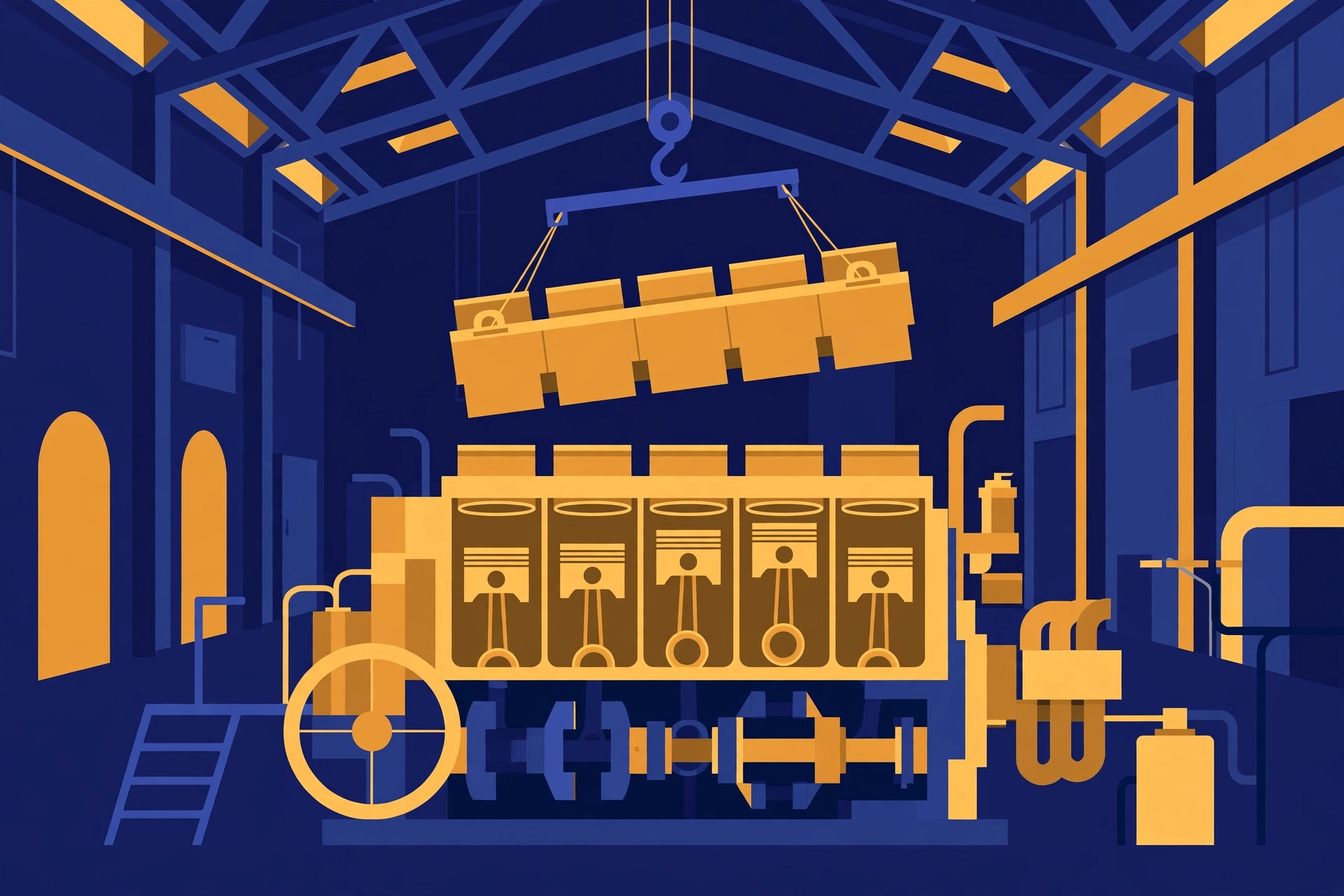 MaintenanceMinor at 30K, Major at 60K — The Rhythm of Engine OverhaulsAn engine wears out on hours, not dates. The 30,000-hour minor is a checkpoint whose measurements shape the 60,000-hour major — and across a 32-engine fleet, sequencing, spares and records are what make the programme work.Read post →
 EnergyWhy the Grid Struggles at 7 pm: Peak Demand, ExplainedThe evening peak is not a shortage of plants. It is a timing problem: demand climbs as solar falls away, and the system must ramp faster than its slowest plant can move — buying the last megawatts from the dear end of the merit order.Read post →