Maintenance
Preventive, Predictive, Condition-Based | Choosing the Right Mix
Preventive, predictive and condition-based maintenance explained without slogans: the bathtub curve, criticality-based strategy assignment, and the two failure modes of maintenance programmes — from plants run at Korangi, SGTPS and KGTPS.

Every maintenance department I've worked in had the same argument, usually in the same words. One camp swears by the calendar: service everything on schedule and failures become rare. Another swears by condition: why open a healthy machine just because a date arrived? Both camps are right about some assets and wrong about others, and the money gets lost in the gap between the slogan and the asset list. The real craft isn't choosing a philosophy. It's assigning the right strategy to each asset, for each phase of its life, and being able to defend that assignment.
The Three Strategies, Honestly Stated
Run-to-failure is the strategy nobody admits to and everybody uses: let it run until it breaks, then fix it. For a cheap, non-critical, easily replaced item — a small fan, a redundant pump — that's not laziness, it's arithmetic. The failure costs less than the prevention would.
Preventive maintenance is time or usage-based intervention: oil changed at fixed hours, filters on a calendar, overhauls at the manufacturer's stated intervals. It's the right answer where wear is genuinely age-related and predictable — and big rotating equipment lives by it, which is why engine overhauls sit at fixed hour marks. Its weakness is just as real: it opens healthy machines, uses up parts with life left in them, and every intrusive intervention carries its own infant-mortality risk.
Predictive or condition-based maintenance intervenes when the asset's own evidence says it's time: vibration spectra trending upward, wear particles multiplying in the oil, a hot spot on a thermographic survey, performance parameters drifting from their baseline. Done properly it catches failures in the window between detectable and destructive — late enough to use the component's full life, early enough to plan the repair instead of suffering it.
The Curve That Settles the Argument
Engineers have drawn the same picture for seventy years: the bathtub curve. Plot an asset's failure rate against its age and you get three distinct regions, each with its own rules.
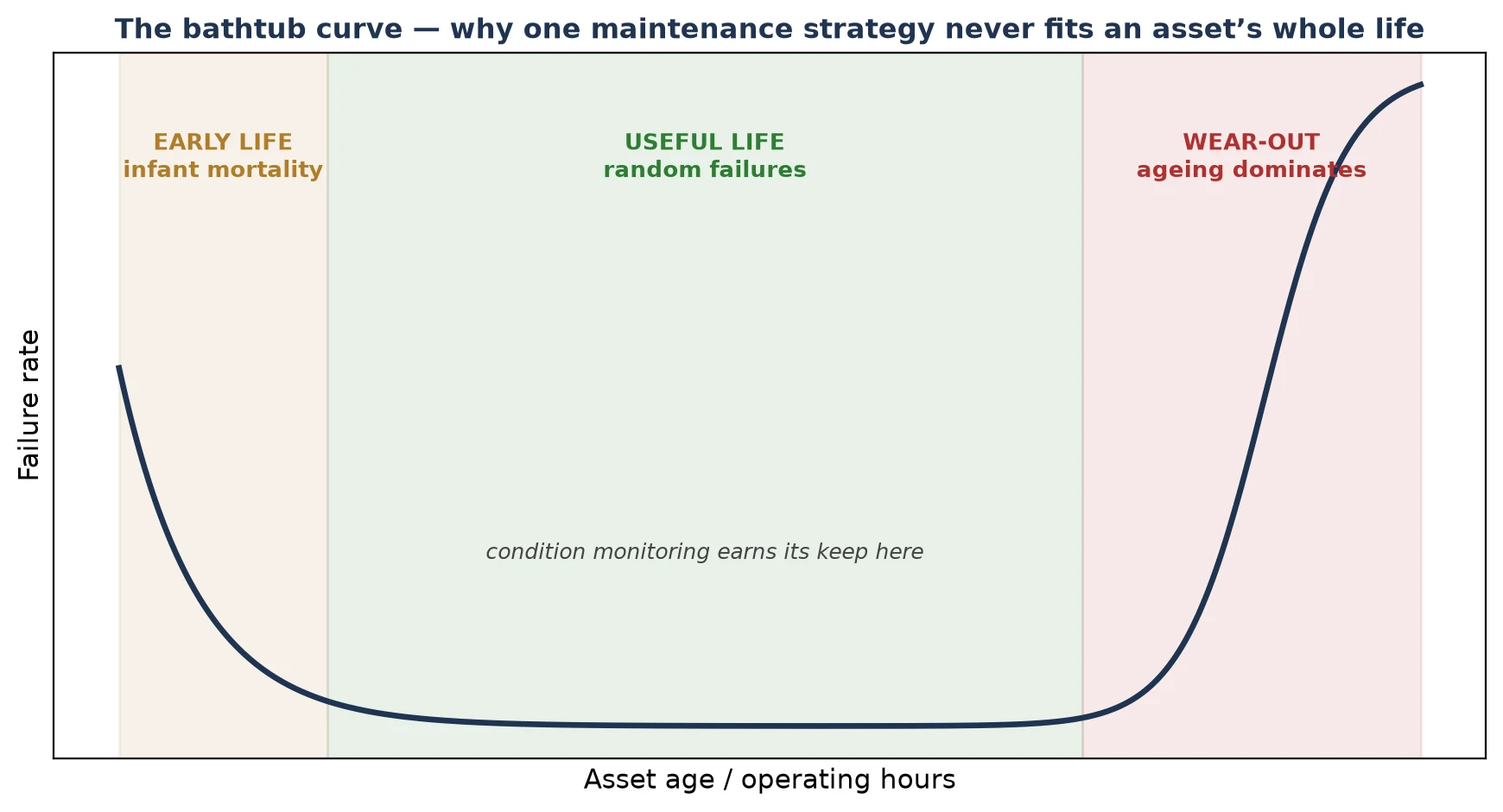
The bathtub curve — one asset, three failure regimes, three different maintenance answers.
In early life, failures come from defects — installation errors, manufacturing flaws, commissioning damage. Calendar-based servicing can't prevent them; only workmanship, testing and warranty discipline can. In useful life, failures are roughly random: a seal lets go, a bearing is unlucky. This is where condition monitoring earns its keep, because random failures still show themselves in vibration, oil and temperature before they destroy anything. In wear-out, ageing dominates and the failure rate climbs relentlessly — and here the preventive camp wins outright, because no amount of monitoring negotiates with a component that has simply used up its life. You replace it on schedule, ahead of the curve.
Any single-philosophy department is therefore right for one phase and wrong for two. The mix isn't a compromise; it's the shape of the physics.
Assigning the Mix, Asset by Asset
In practice the assignment starts with criticality, and criticality is a question about consequences, not about machinery. What happens when this asset stops — does the plant trip, derate, lose redundancy, or merely send someone for a spare? Production consequence, safety consequence, repair cost and detectability together decide the class, and the class decides the strategy: critical and monitorable assets get condition-based coverage with preventive backstops; critical wear items get hard hour-based renewals; non-critical items are honestly run to failure with spares on the shelf, instead of being gold-plated with inspections nobody needed.
At Korangi, this logic ran a 248 MW combined cycle plant; at SGTPS and KGTPS it ran stations of 32 engines each. The scale changes, the questions don't. What changes with scale is the instrumentation you can justify — a fleet of engines makes oil analysis and vibration routes cheap per machine, while a one-off auxiliary may only merit a monthly look, listen and temperature gun.
Two warnings from experience. First, condition monitoring without a response discipline is astrology: an alarm that nobody trends, plans against and acts on is worse than no alarm, because it creates the illusion of coverage. Second, preventive programmes quietly rot — task lists copied forward for years pile up inspections of equipment that was replaced a decade ago and miss the equipment installed since. Both systems, predictive and preventive, are only as good as the asset register underneath them, which is a story about maintenance systems I'll tell separately.
The Takeaway
Stop asking which maintenance philosophy your plant believes in. Ask, asset by asset and phase by phase: what fails, how would we know, what does the failure cost, and which strategy buys the most risk reduction per rupee? The plants that answer those four questions honestly run lean and reliable at the same time. The ones that pick a slogan run one or the other.
Related tools and reading: Vibration Severity Evaluator · Bearing L10 Life Calculator · Inside a 60,000-Hour Overhaul. · Plant Maintenance: The Complete Guide
Further Reading
ISO 55001 — Asset management system requirements (ISO) — the standard that frames the planned, system-driven side of the maintenance mix.
Saad Hafeez is a Chartered Mechanical Engineer and Deputy General Manager – Power Plants at OMS, with condition-based maintenance certification from SKF and maintenance leadership experience across combined cycle and gas-engine fleets.
More from the blog
 ProjectsHow Owners Evaluate Bids — Inside a Techno-Commercial EvaluationA bid that passes pre-qualification, a technical read of the method, prices normalised to one basis and a whole-life view may still not be the cheapest — but it will be the one you can defend, to a board, an auditor, and the plant that has to live with it.Read post →
 MaintenanceMinor at 30K, Major at 60K — The Rhythm of Engine OverhaulsAn engine wears out on hours, not dates. The 30,000-hour minor is a checkpoint whose measurements shape the 60,000-hour major — and across a 32-engine fleet, sequencing, spares and records are what make the programme work.Read post →
 EnergyWhy the Grid Struggles at 7 pm: Peak Demand, ExplainedThe evening peak is not a shortage of plants. It is a timing problem: demand climbs as solar falls away, and the system must ramp faster than its slowest plant can move — buying the last megawatts from the dear end of the merit order.Read post →