Maintenance
Spares Inventory | The PKR 500 Million Balancing Act
At the 248 MW Korangi Power Complex, spares worth over PKR 500 million sat on the warehouse shelves. How a plant stocks insurance spares, rotables and consumables without starving the business either way — and the SAP PM discipline and budget case that keep the inventory honest.

At the 248 MW Korangi Power Complex, you could walk through the warehouse and read the story in the aisles: component after component, each one bought on the same bet. You can't predict the day the plant will need it. And on that day, there will be no time to go shopping. What sat on those shelves was worth north of PKR 500 million. Either the wisest money the station ever spent, or the most expensive insurance policy never properly used. How the inventory is managed decides which one it is.
Two ways to starve a plant
A spares inventory can fail in two directions. Both hurt.
Stock too little, and the plant starves in the obvious way. A unit trips. The failed part isn't on the shelf. Getting a replacement takes weeks — longer still for imported aeroderivative components, which have to cross borders and sit in vendor queues before they reach Karachi. All the while, the station keeps burning fixed costs on a machine that isn't generating. And if you panic-buy by emergency air-freight, you can pay a multiple of what the spare would have cost sitting on the shelf.
Stock too much, and the plant starves quietly. Capital sits in a warehouse instead of working in the business. Parts age where they sit: seals harden, shelf lives run out, electronics go obsolete. They end up as write-offs. Meanwhile carrying, insurance and space costs keep mounting, year after year, on components that may never be touched. Over-stocking isn't safety. It's waste, just quieter.
So the job is to live between the two. That's the balancing act.
What earns a place on the shelf
Every stocking decision comes down to three questions. If it fails, what does the plant lose? How long will a replacement take? And what does waiting cost? How you answer those three sorts the inventory into layers.
Insurance spares are the heavy bets. High value, long lead time, and a failure that would hold a unit down for weeks or months. At a station like Korangi — four GE LM6000 gas turbines, two steam turbines, two waste-heat recovery boilers — this is where the serious money sits. You don't stock them because failure is likely. You stock them because failure without them is unthinkable.
Rotable spares are the working circulation. A component comes off during an overhaul, gets refurbished, and goes back into stock for the next unit. A hot-section exchange on an LM6000 makes the point: the exchange is only fast if the replacement module is already there when the outage starts. Rotables turn overhauls from long shutdowns into planned exchanges.
Consumables and routine parts are the day-to-day stock: filters, gaskets, fasteners, instrumentation spares. Each one is cheap. But miss one, and routine work stops just as surely as if a module were missing. These parts kill you by a thousand cuts — maintenance quality wearing away, bit by bit, when the store is always one gasket short.
Obsolete and dead stock is the fourth layer. Every warehouse has it, and almost nobody manages it. Equipment gets upgraded, vendors discontinue lines, and parts build up that no machine in the plant can use any more. A proper inventory review gets rid of them — sold, scrapped, or written off. Left in place, dead stock distorts the numbers and gives a false sense of coverage.
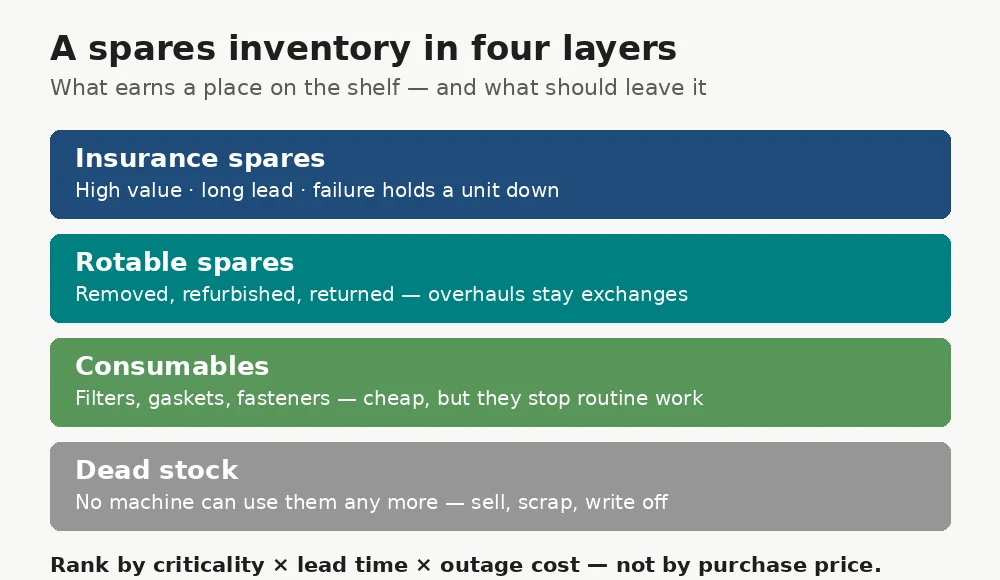
The inventory in one picture: four layers, from the insurance spares that justify themselves by consequence to the dead stock that should leave the warehouse. Illustrative diagram, not warehouse records.
The system behind the shelves
None of this works on paper. In practice, the inventory lives or dies inside the maintenance management system. Running SAP PM, I had every item tied back to the equipment hierarchy — functional locations, equipment records, and the bills of material linking parts to the machines they serve. A work order drew parts from the store. The issue was recorded. Consumption showed up against the job and the asset. That linkage turns a warehouse into a management instrument: you can see consumption by machine, spot dead items, and set stock levels from real demand instead of somebody's anxiety.
But the system is only as honest as the discipline around it. A part issued to a job and never booked. A shelf quietly raided without paperwork. A goods receipt never recorded. Small corruptions like these compound until book stock and physical stock disagree, and then nobody trusts either. The lesson matches what SAP PM teaches throughout: the software gives you the visibility, the people give you the truth.
That visibility feeds the one routine that keeps an inventory honest — the physical count, followed by a classification review. A small fraction of line items carries most of the value. Those deserve attention in proportion to their weight, not the same treatment as a bin of bolts.
Budgets: where spares meet money
Spares sit where the two budgets I managed meet: OPEX and CAPEX. Routine consumption is operating spend, charged to the year it is used. Insurance spares and strategic purchases are capital decisions — money put in now against a risk that may never materialise, defended before owners with lead times, failure consequences and the cost of unavailability.
The annual budget cycle is where the balancing act turns into a negotiation. Finance looks at half a billion rupees in stores and asks whether all of it is necessary. Data is the answer that works: consumption history, lead-time records, outage costs, dead stock identified and removed. An inventory you can defend with numbers survives the budget round. One defended by habit doesn't.
The Takeaway
Put it practically. Don't rank spares by purchase price. Rank them by three things multiplied together: part criticality, replacement lead time, and the cost of an outage. Stock the insurance spares your arithmetic justifies. Keep rotables circulating, so overhauls stay exchanges rather than excavations. Never let consumables stop routine work. Audit the warehouse every year and move the dead stock out. And keep the whole thing visible in your maintenance system, so every issue ties to a work order and every work order ties to an asset. The PKR 500 million is not a number on a balance sheet. It's a bet — and a bet you can't see is a bet you can't manage.
Further Reading
What SAP PM Taught Me About Maintenance Discipline — The system of record behind a working inventory: functional locations, bills of material, and why floor discipline decides whether the system tells the truth.
Inside an LM6000 Hot-Section Exchange — The biggest-ticket spare consumer at a combined cycle station: module replacement and the overhaul logic that keeps rotables circulating.
Plant maintenance — pillar guide — The full guide to maintenance planning, where spares strategy sits alongside overhauls, inspections and budgeting.
ISO 55001:2024 — Asset management system requirements — The international standard's framework for balancing asset cost, risk and performance — the language that turns a spares argument into an asset-management argument.
More from the blog
 ProjectsHow Owners Evaluate Bids — Inside a Techno-Commercial EvaluationA bid that passes pre-qualification, a technical read of the method, prices normalised to one basis and a whole-life view may still not be the cheapest — but it will be the one you can defend, to a board, an auditor, and the plant that has to live with it.Read post →
 MaintenanceMinor at 30K, Major at 60K — The Rhythm of Engine OverhaulsAn engine wears out on hours, not dates. The 30,000-hour minor is a checkpoint whose measurements shape the 60,000-hour major — and across a 32-engine fleet, sequencing, spares and records are what make the programme work.Read post →
 EnergyWhy the Grid Struggles at 7 pm: Peak Demand, ExplainedThe evening peak is not a shortage of plants. It is a timing problem: demand climbs as solar falls away, and the system must ramp faster than its slowest plant can move — buying the last megawatts from the dear end of the merit order.Read post →