Energy
The Old Generator the Renewable Grid Still Needs
A retired thermal plant's alternator is often in excellent condition. As a synchronous condenser it gives the renewable grid inertia and fault current.
I spent part of this year as site manager for the disposal of BQPS-I Units 3 and 4 — two 220 MW units, PKR 4.8 billion of plant, more than 15,000 tons of steel to take apart and sell. The boiler is scrap. The turbine is scrap. But the alternator — the big precision-built generator at the heart of the machine — was in excellent mechanical condition when we took the plant apart.
That is the part worth stopping over. All over the world, the same machine is being kept, uncoupled from its turbine, and put back to work as a synchronous condenser: a spinning stabiliser for grids that are filling up with solar and wind. Before the next demolition tender goes out on a retired thermal plant, the question is worth asking properly. Is the generator scrap, or is it the backbone the clean grid still needs?
What the grid loses when the thermal plants go
For a century, grids ran on heavy rotating machinery. A steam or gas turbine bolted to a multi-ton alternator, spinning at synchronous speed. That spinning mass did three jobs nobody had to pay extra for. It carried kinetic energy that resisted any sudden change in frequency. It pushed several times its own rating in fault current into a short circuit, which is what makes protection relays actually trip. And through its excitation, it held the voltage up or pulled it down as the network needed.
Solar panels have no rotating mass at all. Modern wind turbines have rotors, but the power converter between the rotor and the grid isolates that momentum from the network. So as thermal plants retire and inverter-based generation takes their place, the grid loses all three services at once — and the problems show up in a particular order.
The first is frequency. When a big generator or line trips, the rate at which frequency falls — the rate of change of frequency, or RoCoF — depends on how much spinning mass is left on the system. Less inertia means a faster fall and a deeper dip, and a deeper dip means under-frequency load shedding starts cutting customers off. Operators start seeing this degrade once non-synchronous generation passes roughly 30 to 50 percent of the mix.
The second is fault current. A weak grid — one with low short-circuit strength — cannot deliver the current that protection needs. Distance relays under-reach, breakers hesitate, and the voltage collapses far enough to trip the inverters themselves. The third is the inverters' own control: a grid-following inverter locks onto the grid voltage with a phase-locked loop, and on a weak grid that loop goes unstable. Phase-angle jumps, harmonic resonance, and then a cascade of renewable units tripping off for no fault of their own.
None of this is an argument against renewables. It is an argument that the grid needs its stabilisers replaced when the machines that used to provide them retire. The question is what replaces them, and at what cost.
A generator with nothing to drive
A synchronous condenser is a synchronous machine whose shaft spins freely, with no turbine driving it and no load on it. It is connected to the high-voltage grid through its step-up transformer, synchronised like any generator, and then it just spins. It draws a small amount of real power — typically 0.5 to 2.0 percent of its rating — to cover windage, bearing friction and iron losses. That is the whole running cost in energy terms.
What it gives back is the three things the grid lost. Its rotor stores kinetic energy, and when frequency starts to fall the machine slows slightly and feeds that energy straight back into the network through the air gap. There is no sensor, no software and no delay in that reaction — it is physics, and it happens in the first hundreds of milliseconds after a disturbance, which is exactly when RoCoF is at its worst. Varying the DC excitation in the rotor field windings lets it generate or absorb reactive power continuously, so it holds voltage up during a dip and pulls it down when the network runs high.
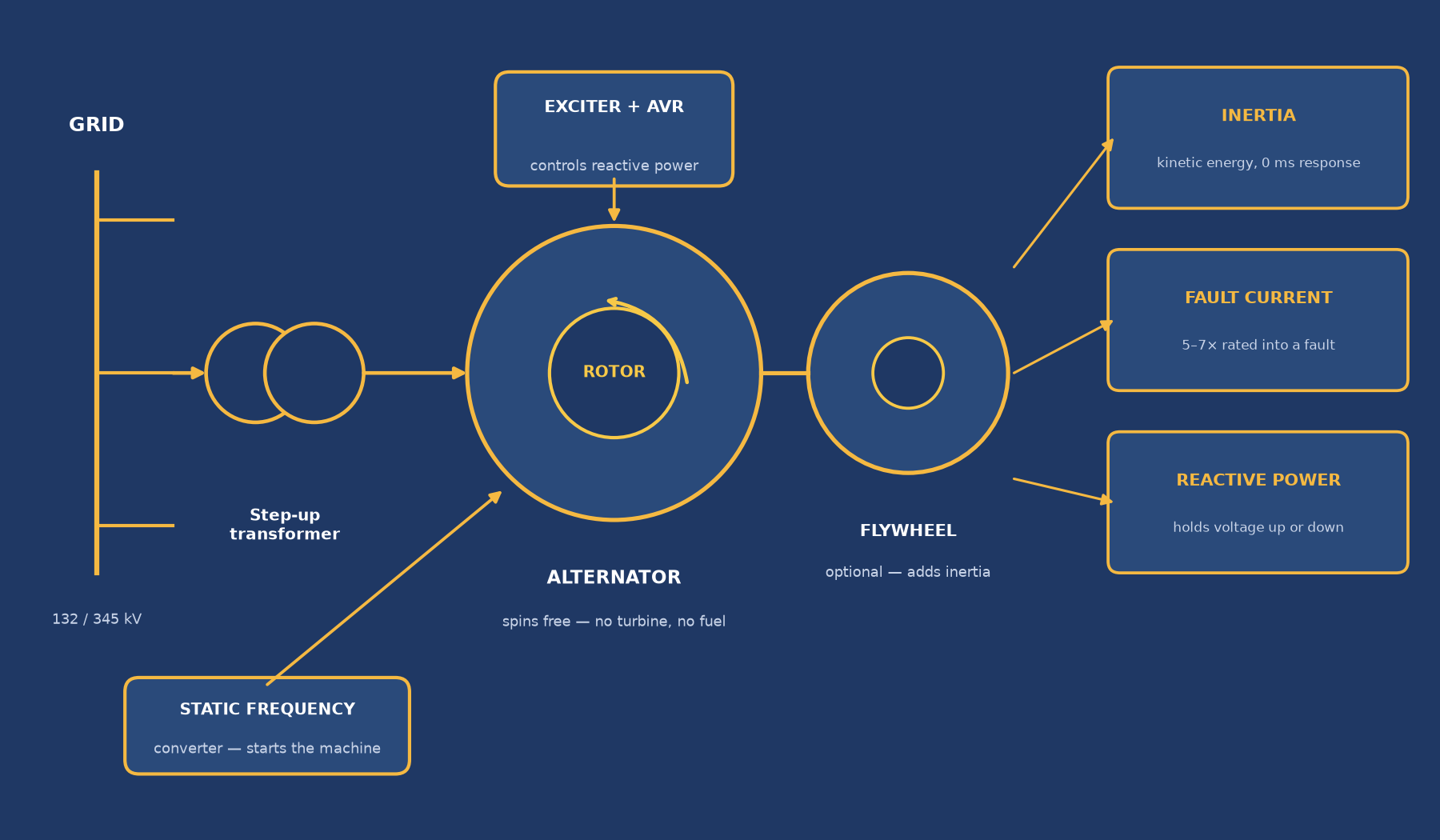
Figure: a synchronous condenser is an alternator spinning free on the grid — no turbine, no fuel. A static frequency converter starts it, the exciter and automatic voltage regulator control reactive power, and an optional flywheel adds inertia. Schematic — the arrangement, not a specific installation.
Starting it takes some thought, because a generator with no turbine has no way to run itself up. The modern answer is a static frequency converter: the stator is back-fed variable-frequency current through the unit auxiliary transformer, and the machine accelerates as a variable-speed motor over a fifteen- to twenty-minute ramp, through its critical speeds, until the synchroniser matches it to the grid and closes the breaker. The older, cheaper answer is a pony motor — a small induction motor, about 1 to 2 percent of the condenser's rating, that spins the rotor up and then disengages on an overrunning clutch. Where a turbine is still meant to run sometimes, a synchronous self-shifting clutch sits between turbine and generator: the turbine starts the set, then throttles to zero fuel and the clutch lets go, leaving the generator spinning as a condenser.
The rest of the conversion is mechanical housekeeping, and it is the part that decides whether the job works. Uncouple the turbine and the generator loses its axial restraint, because the thrust bearing lived in the turbine casing — so a new outboard double-acting thrust bearing goes on a platform at the exciter end. Take tens of tons of turbine rotor off the shaft and the critical speeds move, so the rotor dynamics get re-studied and the old steel gets checked with phased-array ultrasonics and eddy-current scans before anyone trusts it to spin again. The shaft-driven lube oil pump goes with the turbine, replaced by a compact skid with redundant AC pumps and a battery-backed DC pump that can coast the rotor down safely in a blackout. Hydrogen cooling stays where it makes sense, or the machine converts to a closed water-to-air loop. And where the job is mainly about inertia rather than reactive power, a flywheel in a vacuum housing is coupled to the shaft, taking the inertia constant up to 4 to 7 seconds.
The fault-current gap no inverter closes
This is where the rotating machine earns its keep, and it is worth putting numbers on it, because the gap is large. A synchronous condenser delivers 5 to 7 times its rated current into a fault, sustained for tens of cycles, because its copper windings and iron core have the thermal mass to take it. A grid-following solar or wind inverter is capped by its own silicon at about 1.1 to 1.2 times rated current — the IGBTs would destroy themselves if the software let more through. Even an advanced grid-forming battery, which is the best the inverter world offers, reaches about 1.5 to 2.0 times rated current.
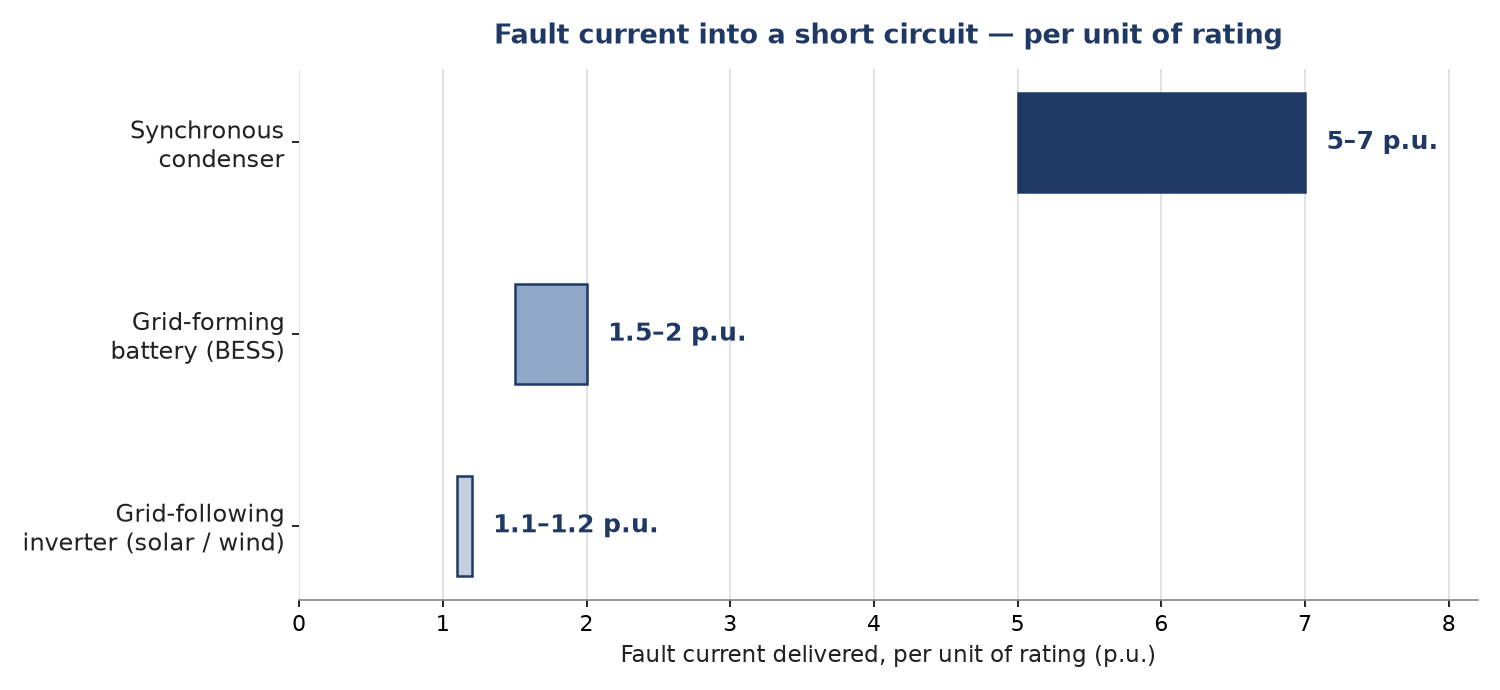
Figure: fault current delivered into a short circuit, per unit of rating. A synchronous condenser delivers 5 to 7 times its rating; a grid-forming battery 1.5 to 2.0; a grid-following inverter 1.1 to 1.2. The inverter limits are set by semiconductor thermal limits, not by software settings.
The same gap shows up in inertia. A repurposed condenser carries an inertia constant of roughly 1.5 to 6 seconds — the time it could supply its full rating from stored kinetic energy alone — and it reacts with zero latency, because there is nothing to measure and nothing to compute. A grid-forming battery synthesises inertia through high-speed control, with a 5 to 20 millisecond delay. A grid-following inverter contributes almost nothing, and needs a strong grid to stay stable in the first place. On overload, the condenser will carry 150 to 200 percent of rating for 10 to 30 seconds; an inverter needs oversized semiconductors to do the same, which is where the money goes.
None of that makes batteries or inverters wrong. They do things a spinning machine cannot — they store energy, they shift load, they respond to price. But fault current and physical inertia are not services an inverter can be tuned into providing. They are properties of mass and copper, and if the grid needs them, something has to spin.
The projects already proving it
The conversions are not theory. FirstEnergy converted Units 4 and 5 at its Eastlake coal plant in Ohio into synchronous condensers, feeding the 138 kV and 345 kV buses, with static frequency converters to start them. The Tennessee Valley Authority retired its Bull Run coal plant after fifty-six years and is turning the set into two 605 MVAR synchronous condensers, keeping the switchyard and the transmission hub intact while solar builds up around it.
In Britain, Siemens Energy repurposed two steam turbine generators at Uniper's Killingholme combined-cycle plant, each fitted with a flywheel, to supply inertia, short-circuit power and reactive power to the grid without burning any fuel. They run under the National Energy System Operator's Stability Pathfinder programme, which tenders long-term contracts for exactly these services — all twelve units from the first phase are now operational, and NESO expects them to save consumers up to £128 million over their lifetime while cutting around 6 million tonnes of CO2. The same idea has been used on a retired nuclear alternator in Germany and on coal units in southern Italy.
The money, and the market problem
A new, greenfield synchronous condenser costs roughly $40 to $80 per kVAR — $18 to $35 million for a 200 to 300 MVAR installation, with twelve to eighteen months' lead time for a forged rotor and stator laminations. A brownfield conversion of an existing alternator comes in 30 to 50 percent cheaper, around $20,000 to $45,000 per MVAR, because the expensive parts are already there: the alternator itself, the step-up transformer — reconditioning it instead of buying new saves $3 to $7 million — the switchyard, the foundations, and the grid connection, which a conversion keeps under its existing rights instead of joining a multi-year interconnection queue.
The real obstacle has never been the engineering. It is that electricity markets pay for energy and treat stability as a free by-product. A plant owner who demolishes a retired unit gets scrap value today; one who converts it gets a machine whose services nobody was paying for. That is changing where regulators have acted. Britain's Pathfinder tenders pay for inertia and short-circuit level directly. Ireland's EirGrid and SONI run a Low Carbon Inertia Service aimed at 14,000 MVA·s of synchronous inertia for a system heading past 75 percent non-synchronous generation. Australia's system strength framework obliges network providers to hold minimum fault levels at key nodes. In the United States, FERC's Schedule 2 reactive power tariffs give converted condensers a cost-of-service revenue base.
The question for Pakistan
Pakistan is heading the same way, on a faster clock than most. The official aim is to lift renewables from around 4 percent of generation today to 30 percent by 2030, and the rooftop solar boom is already changing daytime demand faster than the planning assumed. NTDC has a system stability study underway with CESI under the National Power Transmission Modernization programme — short-circuit analysis, stability analysis, and intermittency studies for solar and wind — which is the right work, and it is happening while the problem is still manageable.
The question is whether we plan system strength before the trips start, or after. Every thermal plant that retires in Pakistan is the same choice I faced at BQPS-I: the boiler is scrap, but the alternator is a precision machine in good condition, sitting on a foundation with a transformer, a switchyard and a grid connection already built. Demolishing it is a one-off scrap receipt. Converting it is a stability asset that earns for decades. The engineering is established, the projects exist, and the cost of a conversion is a fraction of building the same capability from scratch. What it needs is a procurement route that pays for inertia and fault current the way it already pays for megawatts.
Before the next demolition tender goes out on a retired thermal unit, someone should have to answer one question: is this generator scrap, or is it the shock absorber the renewable grid is going to need?
Further Reading
- Decommissioning a Power Plant Properly — The BQPS-I Disposal — the disposal I ran as site manager, and the other half of this question: what taking a plant apart actually involves.
- Pakistan's Energy Mix in Five Charts: What Changed in Five Years — where Pakistan's capacity and generation have actually moved, and why the mix matters for stability.
- How Owners Evaluate Bids — Inside a Techno-Commercial Evaluation — how a technical and commercial case for a conversion like this gets judged.
- Siemens Energy — Killingholme turbine conversion — two steam turbine generators repurposed as synchronous condensers with flywheels.
- NESO — First phase of Stability Pathfinders delivered — all twelve first-phase units operational, and what they are expected to save.
- Power Engineering — TVA moves forward with grid stability project at retired coal plant — Bull Run's two 605 MVAR synchronous condensers.
- CIGRE USNC — Synchronous condenser conversions at FirstEnergy Eastlake — the Eastlake Units 4 and 5 conversion paper.
- CESI — System studies for NTDC grid stability, Pakistan — NTDC's stability study under the National Power Transmission Modernization programme.
Sources
1. Repurposing decommissioned thermal turbomachinery as synchronous condensers — engineering architecture, grid stability economics and case studies (working paper supplied for this post, 13 pp., 36 references). Engineering figures in this post — losses 0.5–2.0% of rating, fault current 5–7 p.u. against 1.1–1.2 p.u. grid-following and 1.5–2.0 p.u. grid-forming, inertia constant H 1.5–6.0 s (4–7 s with flywheel), overload 150–200% for 10–30 s, greenfield $40–80 per kVAR and brownfield $20,000–45,000 per MVAR with 30–50% savings — are from this document's comparison tables and economics section.
2. Siemens Energy, Killingholme turbine conversion (reference page, accessed 6 November 2026) — two steam turbine generators repurposed at Killingholme, each with a flywheel, providing inertia, short-circuit power and reactive power without burning fossil fuels; operational 2021 under the Stability Pathfinder programme. siemens-energy.com
3. National Energy System Operator, First phase of Stability Pathfinders delivered, 5 April 2023 (accessed 6 November 2026) — all 12 first-phase units operational; expected to deliver up to £128 million in consumer savings and cut around 6 million tonnes of CO2. neso.energy
4. Power Engineering (Kevin Clark), TVA moves forward with grid stability project at retired coal plant (accessed 6 November 2026) — Bull Run conversion to two 605 MVAR synchronous condensers. power-eng.com
5. CIGRE USNC, Synchronous condenser conversions at FirstEnergy Eastlake Plant (Slattery, accessed 6 November 2026) — Units 4 and 5 converted, feeding 138 kV and 345 kV buses. cigre-usnc.org
6. CESI, System studies for the review of grid system performance and proposals for system stability improvement under Pakistan National Power Transmission Modernization Phase 1 Project (accessed 6 November 2026) — NTDC stability study, 2022–ongoing, including short-circuit, stability and renewables intermittency analysis. cesi.it
7. Global Solar Council, NTDC to build a secure, sustainable energy future for Pakistan (accessed 6 November 2026) — Pakistan aiming to raise renewables from 4 percent today to 30 percent by 2030. globalsolarcouncil.org
8. Siemens Energy, Siemens Energy awarded contracts to enable Uniper to provide grid stability services (press release, accessed 6 November 2026) — two new synchronous condenser units at Grain and two repurposed steam turbine generators at Killingholme. siemens-energy.com
9. Uniper, Grid stability technology without the need to generate power comes into operation at Killingholme (accessed 6 November 2026) — Killingholme condensers in operation. uniper.energy
Figures: the condenser schematic and the fault-current chart were drawn for this post from the engineering figures above. The BQPS-I disposal figures (2×220 MW, PKR 4.8 billion, 15,000 tons) are from the author's own project record as site manager.
More from the blog
 ProjectsDecommissioning a Power Plant Properly — The BQPS-I DisposalTaking a power plant apart is a project in its own right. The BQPS-I disposal — 2×220 MW, PKR 4.8 billion, 15,000 tons — and the method behind it: survey and record, top-down sequence, heavy lifts, preservation, and the scope line drawn before work starts.Read post →
 EnergyPakistan's Energy Mix in Five Charts — What Changed in Five YearsPakistan added 7,169 MW of capacity in four years and generated less electricity. Five charts show why the mix moved, who runs and who sits idle, where the power leaks, and the solar the official numbers barely see.Read post →
 ProjectsHow Owners Evaluate Bids — Inside a Techno-Commercial EvaluationA bid that passes pre-qualification, a technical read of the method, prices normalised to one basis and a whole-life view may still not be the cheapest — but it will be the one you can defend, to a board, an auditor, and the plant that has to live with it.Read post →