Projects
Decommissioning a Power Plant Properly — The BQPS-I Disposal
Taking a power plant apart is a project in its own right. The BQPS-I disposal — 2×220 MW, PKR 4.8 billion, 15,000 tons — and the method behind it.

A power station does not end when it stops generating. It ends when the last piece of steel leaves the site and the paperwork closes. I was site manager for the disposal of BQPS-I Units 3 and 4 — two 220 MW units, a PKR 4.8 billion disposal, more than 15,000 tons of plant, and a boiler 50 metres tall. It taught me something most engineers only learn the hard way: taking a plant apart is a project in its own right, and it deserves the same planning as building one.
There are two ways a plant comes apart, and the method changes completely between them. One ends at the weighbridge: the plant is cut up, segregated and sold as scrap and equipment. That was BQPS-I. The other ends in a crate: the plant is taken apart so it can be rebuilt somewhere else, and every piece has to arrive in a condition to be reinstalled. That is a reverse-engineering job, not a demolition job — and it is the harder of the two. This post covers both, because the discipline is the same and the difference is in the detail.
The scale of the job
Start with the numbers, because they set everything else. Two units at 220 MW each. A boiler 50 metres tall — about a 15-storey building. More than 15,000 tons to remove: boiler steel, an ANSALDO 210 MW steam turbine, its generator and transformer, piping, cabling, ductwork and structures. A disposal valued at PKR 4.8 billion.
That last figure is the one people outside the industry get wrong. They hear "disposal" and think "cost". A plant being taken apart is also a sale: the steel, copper and equipment have value, and realising it is part of the job. Fifteen thousand tons is not a number you manage with a skip and a cutting torch. It is a logistics operation — cranes, trucks, a weighbridge and a register — run like one from day one.
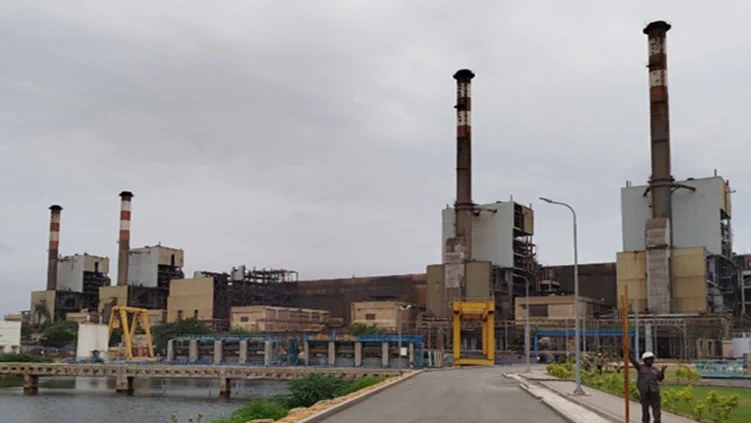
Figure: BQPS-I with the stacks of Units 3 and 4 removed. Photo: author's project record.
Before a single bolt comes off
The first work on a disposal is not demolition. It is the survey, and it has to be physical. A station that has run for decades has services buried in drawings that no longer match reality, so the survey is a walkdown, not a desk exercise. The engineers walk the plant against the piping and instrumentation diagrams and the electrical single-line diagrams, and they record what is actually there: every isolation point, every live service still connected, every line that the drawings forgot.
Then the recording starts. Before anything is disconnected, the team photographs and videos the plant as it stands — every disconnection point close up: piping flanges, terminal blocks, junction boxes, instrument tie-ins, cable routes, fragile components. Every intersecting flange, structural joint and duct section gets match-marked with a permanent industrial marker, so two pieces that came apart can be put back together in only one way. Every cable gets scheduled and tagged at both ends, field instrument and control panel. All of it goes into one database, cross-referenced with updated drawings, so the reassembly team months later has a blueprint instead of a puzzle.
The lifting plan gets the same treatment. Before a crane comes on site, the heavy-lift engineers walk the approved rigging study on the ground: crane set-up positions, swing radius against overhead clashes, and ground strength under the outriggers. A crane that sinks an outrigger into soft ground is a stopped job at best. Laydown and storage areas are set out, hard barricades and warning signs go up around the dismantling zones, and the work area is isolated from any plant still running next door.
Skip this stage and the job pays twice: once in the delay when a live line or an unrecorded connection turns up mid-cut, and once in the risk it carried until then.
Take it down in the right order
A 50-metre boiler does not come down in one piece, and the order matters more than the method. The rule is top-down: remove the non-structural elements first, then work down through the structure, keeping it stable at every step. That is the principle the UK Health and Safety Executive sets out in its demolition guidance: take the structure down progressively, control the debris, and keep exclusion zones sized to how far material can fall. A boiler's stability changes as you remove mass from it, so the sequence has to be planned by someone who understands load paths. A crane on its own is not a plan.
On a combined cycle plant the sequence runs as a work breakdown structure, and each step clears the way for the next. The air intake and filter house come off first, opening the space the main lifts need. Then the auxiliary skids, one by one: lube oil, gas filters, CO2, demi water, chromatograph, natural gas booster compressors, the emissions monitoring system. The generator is disconnected from the gearbox and lifted out, then the generator room structure follows. The gas turbine core comes next: the rotor is locked first, and the lift is done under the direct supervision of the manufacturer's field service representative, on the OEM spreader beam, so the machine is handled exactly as the manufacturer prescribes. The exhaust and heat recovery steam generator are taken top-down: diverter damper first, then the stack, then the top structure, then the internals in order — superheater, evaporator, economizer. Electrical and instrumentation panels come last, followed by systematic cable pulling.
Every piece in that sequence is sized to the crane on site and the road out of it. Get the order wrong and you end up cutting around a component that should already have been lifted, or holding up a structure that has lost the members keeping it standing.
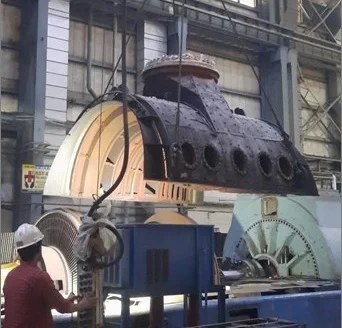
Figure: a turbine casing half removed in the turbine hall at BQPS-I. Photo: author's project record.
Turbine hall work during the BQPS-I disposal (11 seconds).
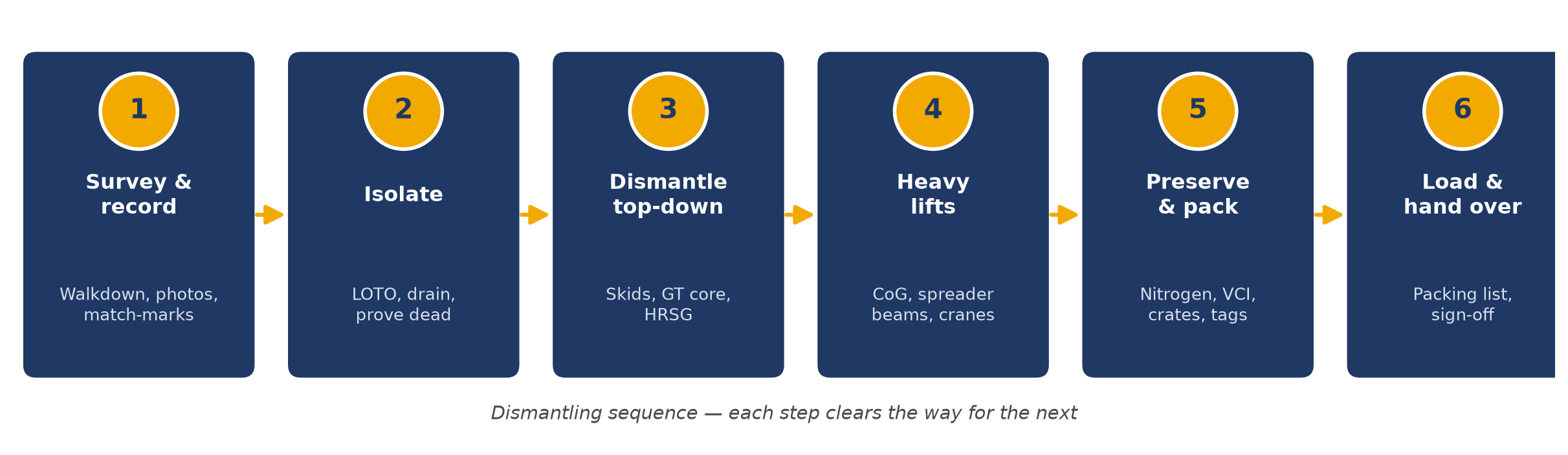
Figure: the six steps of a plant dismantling, in order — survey and record, isolate, dismantle top-down, heavy lifts, preserve and pack, load and hand over. Schematic — the steps and their order, not measured data. Sources: author's project record as Site Manager for the BQPS-I disposal; method per the UK Health and Safety Executive's demolition guidance and an OMS dismantling method statement (May 2026).
The heavy lifts
A lift on a dismantling job is engineered, not improvised. The starting point is the weight and the centre of gravity of every major piece, and the lift is designed around them. A perfectly level lift is the whole point: if the load tilts, the forces stop being vertical, casings deform, and machined surfaces take damage that no amount of preservation will fix. That is why the heavy pieces are lifted on spreader beams matched to their centre of gravity — the beam takes the horizontal forces so the equipment does not.
Take the numbers from a co-generation plant dismantling plan: the generator alone weighed 72.9 tonnes, the gas compressor skid 82.7 tonnes, the generator and gearbox room 55.8 tonnes, each HRSG module 25 tonnes, the main stack bottom section 30 tonnes, the high-pressure steam drum 23 tonnes. Those numbers decide the cranes. On that plan the critical lifts went to a 200-tonne crane — the generator and the turbine core — because capacity is judged at the working radius, not at the crane's headline rating. A 40-tonne mobile crane took the mid-range work, HRSG modules and stacks, and a 12-tonne crane handled the daily dismantling and logistics. Every sling, shackle, spreader beam and chain block is load-tested and third-party certified, and every crane is checked at the site entrance before it is allowed in. Shackles on the heaviest lifts run to 85–120 tonnes safe working load. Precision load levellers — high-capacity chain blocks rigged in line with the tackle — hold the load level while it is detached and lowered.
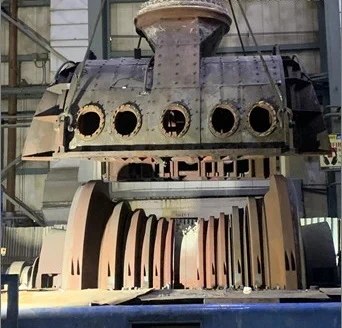
Figure: a turbine casing section being lifted out at BQPS-I, with the rotor exposed below. Photo: author's project record.
None of this is over-engineering. A dropped generator is not a delay, it is the end of the asset. And on a dismantling job the crane is usually working over people, over structures that are being taken apart, and over ground that was never designed for a 200-tonne machine. Ground bearing is checked before the outriggers go down, not after.
If it is going to be rebuilt: preservation
This is where the two kinds of dismantling part company. When the plant is going for scrap, the value is in the metal. When it is going to be rebuilt, the value is in the condition of every component — and condition is lost in weeks if nobody protects it.
Every open nozzle, pipeline, intake and exhaust opening gets blinded with a rigid cover — metal or wood with a rubber gasket — and the smaller openings are sealed with heavy-duty plastic and caps. The turbine lube oil sump and its piping are drained, flushed and fogged with a vapour-corrosion-inhibitor oil, so the machined surfaces inside do not rust in storage. Critical vessels — the steam drum, the gas turbine's internal pathways — are purged and filled with nitrogen and sealed at a slight positive pressure, so oxygen and moisture cannot get back in. Electrical and instrumentation panels and every moisture-prone component are packed with high-capacity desiccant and wrapped in heavy plastic.
Then the packing. Major equipment — the gas turbine core, the main generator, the fragile auxiliary skids — goes into heavy wooden export boxes built for sea transport. And every piece, boxed or not, gets an engraved aluminium tag wired on with stainless steel wire: dimensions, gross weight, and a unique cross-referenced code. Paper labels wash off and fall off; an engraved tag is still readable after months in a yard and a sea voyage. That tag is what makes reassembly possible. Without it, the reassembly team has a yard full of steel and no idea which piece goes where.
The handover at the end is a document, not a handshake: a master packing list of every dismantled component, confirmed identification markings on the major equipment, and formal sign-off that the whole job was executed exactly as the approved rigging study set out. On a disposal the equivalent is the weighbridge register. Either way, the paperwork is the product.
Safety is the method, not a section
Everything above is also a safety argument. Hot work on a structure that still holds fuel residues. Work at height on a boiler that is getting shorter every week. Cranes swinging loads over people. Dust, noise, and trucks moving through a live industrial site. It is a construction site's hazard list, plus the ones the plant itself left behind.
So the job runs on the same discipline as the operating plant. No task starts without an approved permit to work, every person on site is inducted, and every day starts with a toolbox talk on the specific task ahead. Lock-out and tag-out is done properly, in two halves. Electrical: every isolation is positively identified, every cable is marked accurately and disconnected from both ends before any structural work starts. Mechanical: lube oil drained, cooling water drained, CO2 cylinders vented and discharged safely, every pipeline drained and vented so there is no stored energy left anywhere. All hand tools, power tools and cutting equipment are inspected daily. Cranes and rigging are third-party certified and checked at the gate. Housekeeping is daily and mandatory, because a cluttered laydown area is where a rigging accident starts.
That is why the disposal ran on the same process-safety discipline as the operating plant. I had led the DuPont process safety management implementation drive at Korangi, and the habits carry across: permits, isolation, a job safety analysis before work starts, and a stop-work rule anyone can call. Schedule pressure on a disposal is real — every week of delay costs money — but the moment the schedule starts deciding the sequence, you have lost control of the job.
What the drawings don't tell you
Every dismantling price is built on assumptions, and the assumptions are where the job goes wrong. The drawings say the fasteners will come undone; the plant says they have been seized solid for twenty years. The drawings show a lifting lug; the lug is damaged, or a welded modification the drawings never recorded has covered it. The drawings show the structure; they do not show the undocumented pipe run, the buried cable trench, or the ducting that collapsed behind a panel.
A proper method statement names these things up front and draws a line around the scope. Dismantling stops at the first isolation valve or just outside the plant footprint — the tie-ins to a live plant next door are not yours to touch. It stops at the base plates and foundation bolts — breaking concrete foundations and pedestals is civil demolition, a different job. The drained oils, coolants and chemicals are collected and sealed into drums, but their permanent disposal off site sits with the plant owner. Transport and freight sit outside the dismantling scope, and so does the ongoing preservation — the nitrogen top-ups, the desiccant changes, the routine inspections after handover.
None of that is small print. It is the difference between a price and a surprise. The survey, the walkdown and the recording exist precisely because a dismantling job is full of concealed conditions, and every one of them that turns up mid-job costs time, changes the sequence, or changes the crane plan.
What comes out is worth money
Once cutting starts, the job turns into a materials operation. Steel, copper, aluminium, stainless, transformers, motors, valves, instruments: each stream has a different buyer and price, and mixing them destroys value. Segregation has to happen at the point of cutting, not at the gate. That means marked laydown areas, weighbridge records, and a register that tracks what left, when, and to whom.
This is where the PKR 4.8 billion figure lives or dies. A disposal contract that pays on tonnage needs verified weights. A contract that sells equipment needs an inventory a buyer can trust. Either way, the paperwork is as much the product as the scrap. I have written before about how owners evaluate bids, and a disposal is no different: the cheapest bidder is not the best one if they cannot show how they will cut, lift, weigh and account for 15,000 tons.
The Takeaway
If you are ever handed a plant to take apart, treat it like a construction project — run in reverse. Survey it physically, because the drawings will be wrong somewhere. Record everything before you disconnect it, because the reassembly team only has what you wrote down. Plan the sequence top-down so the structure stays stable, and engineer every heavy lift around its centre of gravity. If the plant is going to be rebuilt, preserve it like it matters, because it does — blind the openings, blanket it in nitrogen, crate it, and tag every piece so it can be found again. Draw the line around your scope before you start, and keep records a buyer, an auditor and a reassembly team can all follow. The steel is the easy part. The value — and the safety — is in the planning. A plant that took years to build deserves more than a few weeks of cutting to take down.
Further Reading
How Owners Evaluate Bids — Inside a Techno-Commercial Evaluation — How a disposal contract gets judged before it is awarded, and what separates a capable bidder from a cheap one.
Plant Maintenance Guide — The maintenance discipline — isolation, permits, work orders — that a disposal runs on.
Our Services — Performance testing, maintenance and asset work, including plant disposal support.
Demolition — HSE guidance — The UK Health and Safety Executive's guidance on planning demolition: top-down methods, structural stability, exclusion zones and the sequence of work.
Decommissioning of nuclear installations — IAEA — The IAEA on decommissioning as a planned, regulated phase of a facility's life; the same principle applies to conventional plant.
Sources
1. The figures for the BQPS-I disposal — two 220 MW units, PKR 4.8 billion, 15,000+ tons of material, 50 m boiler — are from the author's own project record as Site Manager for the disposal. No external source is cited for them because they are first-hand project facts.
2. UK Health and Safety Executive, Demolition guidance — top-down demolition method, structural stability during dismantling, exclusion zones, and the sequence of work. hse.gov.uk (accessed 6 November 2026)
3. International Atomic Energy Agency, Decommissioning of nuclear installations — decommissioning as a planned phase of facility life, with a final decommissioning plan covering dismantling strategy, worker and public protection, environmental impact and material management. iaea.org (accessed 6 November 2026)
4. OMS (Private) Limited, Techno-commercial proposal for dismantling, packing and loading of a co-generation plant, May 2026 (project document, unpublished) — the dismantling sequence, heavy-lift weights and crane selection, preservation practice, and scope boundaries used in this post. The co-generation plant figures are from the proposal's method statement; the project itself was proposed, not executed.
5. Photographs and video in this post are from the BQPS-I disposal project, as published on the author's projects page. saadhafeez.online/projects.php (accessed 6 November 2026)
More from the blog
 EnergyThe Old Generator the Renewable Grid Still NeedsWhen a thermal plant retires, the grid loses its shock absorbers \u2014 inertia, fault current, voltage control. The alternator left behind can give all three back, spinning free, burning no fuel, for a fraction of the cost of building new.Read post →
 EnergyPakistan's Energy Mix in Five Charts — What Changed in Five YearsPakistan added 7,169 MW of capacity in four years and generated less electricity. Five charts show why the mix moved, who runs and who sits idle, where the power leaks, and the solar the official numbers barely see.Read post →
 ProjectsHow Owners Evaluate Bids — Inside a Techno-Commercial EvaluationA bid that passes pre-qualification, a technical read of the method, prices normalised to one basis and a whole-life view may still not be the cheapest — but it will be the one you can defend, to a board, an auditor, and the plant that has to live with it.Read post →